Over 80 percent of British businesses now use email marketing to connect with their audiences in a more personal way. As digital competition increases, understanding how to reach the right people through effective online communication has never been more important. This guide explores the must-know principles and practical strategies that make email marketing an essential tool for growing relationships and driving measurable results in the British market.
Table of Contents
- Defining Email Marketing And Core Concepts
- Types Of Email Marketing Campaigns
- How Email Marketing Drives Engagement
- Automation, Personalisation, And Segmentation
- Common Pitfalls And How To Avoid Them
Key Takeaways
| Point | Details |
|---|---|
| Importance of Email Marketing | Email marketing connects businesses directly with their audience, enhancing customer relationships and driving engagement. |
| Types of Campaigns | There are various email campaign types, including promotional, transactional, and newsletters, each serving unique objectives. |
| Engagement Strategies | Personalisation, targeted communication, and measurable interactions are key mechanisms for driving customer engagement through email. |
| Common Pitfalls | Entrepreneurs must avoid compliance issues, generic messaging, and technical mistakes to maximise campaign effectiveness. |
Defining Email Marketing and Core Concepts
Email marketing is a powerful digital communication strategy that enables businesses to connect directly with their audience through targeted electronic messaging. At its core, email marketing involves sending commercial messages via email to a group of people with specific strategic objectives.
The fundamental purpose of email marketing goes beyond simple promotional tactics. It encompasses multiple critical business goals, including:
- Enhancing relationships with current and previous customers
- Encouraging customer loyalty and repeat engagement
- Acquiring new potential clients
- Promoting immediate product or service purchases
- Building sustained brand awareness
When executed effectively, email marketing serves as a precision instrument for digital communication. Direct marketing strategies using email allow businesses to segment audiences, personalise messaging, and track precise performance metrics in real-time. Unlike broad advertising channels, email marketing provides granular insights into recipient behaviour, enabling marketers to refine their approaches continuously.
Successful email marketing requires understanding several core components: audience segmentation, compelling content creation, strategic timing, responsive design, and robust analytics tracking. Entrepreneurs and digital marketers must view email not just as a communication tool, but as a sophisticated relationship-building platform that connects businesses directly with their most interested potential customers.
Types of Email Marketing Campaigns
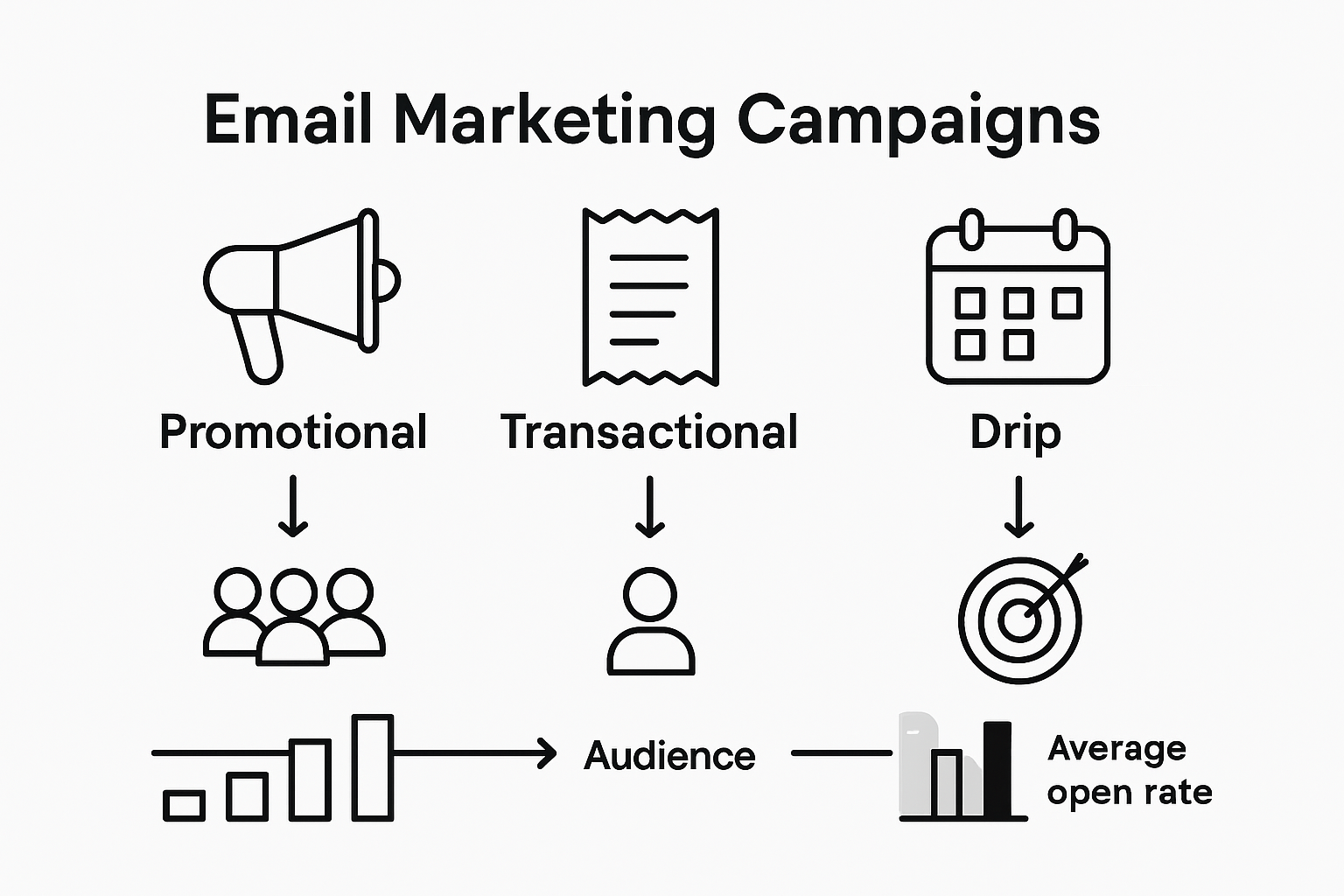
Email marketing encompasses several strategic campaign types, each designed to achieve specific communication objectives. Email marketing campaigns can be broadly categorised into distinct formats that serve unique purposes for businesses seeking to engage their audience effectively.
The primary types of email marketing campaigns include:
- Promotional Campaigns
- Highlight special offers
- Announce product launches
- Generate immediate sales opportunities
- Create time-sensitive incentives
- Transactional Campaigns
- Order confirmations
- Shipping notifications
- Account updates
- Payment receipts
- Newsletters
- Regular industry insights
- Company updates
- Educational content
- Audience relationship maintenance
Strategic email campaign approaches extend beyond these traditional formats. Advanced marketers now utilise sophisticated segmentation techniques to develop highly targeted communications such as lead nurturing campaigns, industry-specific updates, and interactive survey emails.
Successful email marketing requires understanding the nuanced objectives of each campaign type. Entrepreneurs must craft messages that not only inform but also build meaningful connections, transforming routine communications into opportunities for engagement, trust-building, and ultimately, conversion. The most effective campaigns seamlessly blend valuable content with strategic messaging, ensuring recipients perceive genuine value in every interaction.
How Email Marketing Drives Engagement
Customer engagement represents the cornerstone of successful digital marketing strategies, and email marketing excels at generating meaningful interactions through targeted, personalised communication channels. By delivering precisely crafted messages directly to recipients’ inboxes, businesses can create immediate, measurable connections with their audience.
The primary mechanisms through which email marketing drives engagement include:
-
Personalisation
- Tailoring content to individual preferences
- Segmenting audiences based on behaviour
- Creating contextually relevant messaging
-
Targeted Communication
- Delivering timely, specific information
- Addressing specific customer pain points
- Providing value-added insights
-
Measurable Interactions
- Tracking open rates
- Monitoring click-through rates
- Analysing customer response patterns
Effective email marketing strategies transform routine communications into powerful engagement tools. By understanding recipient behaviour, businesses can craft messages that not only inform but also inspire action, creating a dynamic conversation between brand and customer.

Successful engagement requires more than simply sending emails. Entrepreneurs must develop a nuanced approach that balances informative content, strategic timing, and genuine value proposition. The most impactful email campaigns anticipate customer needs, provide solutions before they are requested, and build trust through consistent, meaningful communication.
Automation, Personalisation, and Segmentation
Email marketing sophistication emerges through three interconnected strategies that transform routine communications into powerful engagement tools. Advanced neural frameworks now enable marketers to integrate automation, personalisation, and segmentation with unprecedented precision and effectiveness.
Key components of this strategic approach include:
Automation Strategies
- Trigger-based email sequences
- Scheduled campaign deployments
- Workflow management
- Consistent messaging delivery
Personalisation Techniques
- Dynamic content adaptation
- Individual user preference tracking
- Behaviour-based recommendations
- Contextual messaging
Segmentation Methods
- Demographic clustering
- Purchase history analysis
- Engagement level categorisation
- Interest-based grouping
Prototype-based multi-view networks represent the cutting edge of predictive email marketing, enabling businesses to develop nuanced communication strategies that anticipate and respond to individual customer preferences. These advanced systems move beyond traditional segmentation by creating intricate, adaptive models of customer behaviour.
Successful implementation requires a holistic approach that balances technological capability with human insight. Entrepreneurs must view automation, personalisation, and segmentation not as isolated tactics, but as an integrated system designed to create meaningful, relevant customer experiences. The most effective email marketing strategies transform data into genuine connections, turning every communication into an opportunity for deeper engagement.
Common Pitfalls and How to Avoid Them
Email marketing excellence demands strategic awareness of potential challenges that can undermine campaign effectiveness. Understanding critical privacy considerations becomes paramount for entrepreneurs seeking sustainable digital communication strategies.
Common email marketing pitfalls include:
Compliance and Permission Issues
- Sending unsolicited communications
- Failing to obtain clear subscriber consent
- Ignoring unsubscribe requests
- Neglecting data protection regulations
Content and Engagement Challenges
- Generic, non-personalised messaging
- Inconsistent email frequency
- Overwhelming subscribers with excessive content
- Lack of clear value proposition
Technical and Strategic Mistakes
- Poor email list management
- Inadequate segmentation
- Ineffective subject line strategies
- Neglecting mobile responsiveness
Decision-making frameworks in email campaigns reveal sophisticated approaches to mitigating engagement challenges. Successful marketers recognise that avoiding pitfalls requires a proactive, data-driven strategy that prioritises recipient experience and demonstrates genuine value.
Navigating these challenges demands continuous learning and adaptability. Entrepreneurs must develop a nuanced approach that balances technical precision with human-centric communication, transforming potential obstacles into opportunities for meaningful connection and trust-building.
Unlock the Power of Email Marketing for Your Digital Success
Struggling to turn email strategies into real customer engagement or revenue This article highlights common challenges like poor personalisation, weak segmentation, and engagement pitfalls that can stunt your marketing growth. If your goal is to start building meaningful relationships with your audience while driving conversions email marketing you can rely on is within reach.
Discover practical solutions that help you automate, personalise, and target your email campaigns effectively with tools designed for beginners. At Steve Pritchard Online we understand that no one wants to waste time or get overwhelmed by tech headaches. That is why our range of digital products focuses on simplifying marketing efforts with ready-made assets such as AI-powered content tools and marketing templates curated especially for your needs.
Explore our Marketing – Steve Pritchard Online collection to find step-by-step guides and lead-generation resources that empower you to engage your audience confidently. Start turning your email marketing challenges into opportunities today by visiting Steve Pritchard Online and take the next step to grow your online income stream quickly without the usual frustration.
Frequently Asked Questions
What is email marketing?
Email marketing is a digital communication strategy that involves sending targeted commercial messages via email to a group of people, aiming to achieve specific business goals like customer engagement and brand awareness.
How does email marketing drive customer engagement?
Email marketing drives engagement by delivering personalised content to recipients’ inboxes, using targeted communication, and providing measurable interactions, which foster immediate connections between the business and the customer.
What are the types of email marketing campaigns?
The main types of email marketing campaigns include promotional campaigns (for special offers), transactional campaigns (like order confirmations), and newsletters (providing industry insights and updates).
How can I improve my email marketing effectiveness?
Improving email marketing effectiveness involves employing strategies like audience segmentation, personalisation of messages, maintaining consistent email frequency, and ensuring compliance with data protection regulations.
Recommended
- Unleash Your Affiliate Superpowers with AI
- PromoBlitz – AI-Powered Affiliate Content Generator | Steve Pritchard Online
- Products – AI-Powered Marketing Tools | Steve Pritchard Online
- Sales Page – Steve Pritchard Online
- Understanding the Importance of Customer Communication – My WordPress
- 7 Key Digital Marketing Trends 2025 for Malaysian Buyers – Projector Display
- Email Marketing Best Practices: Complete Guide