More than 50 percent of british businesses report that tailored email campaigns lead to significantly higher engagement and sales. In an increasingly crowded inbox, reaching the right audience with the right message is crucial for any brand hoping to stand out. This practical guide walks you through simple, proven steps that help british marketers connect with their target customers, build lasting relationships, and drive real campaign results.
Table of Contents
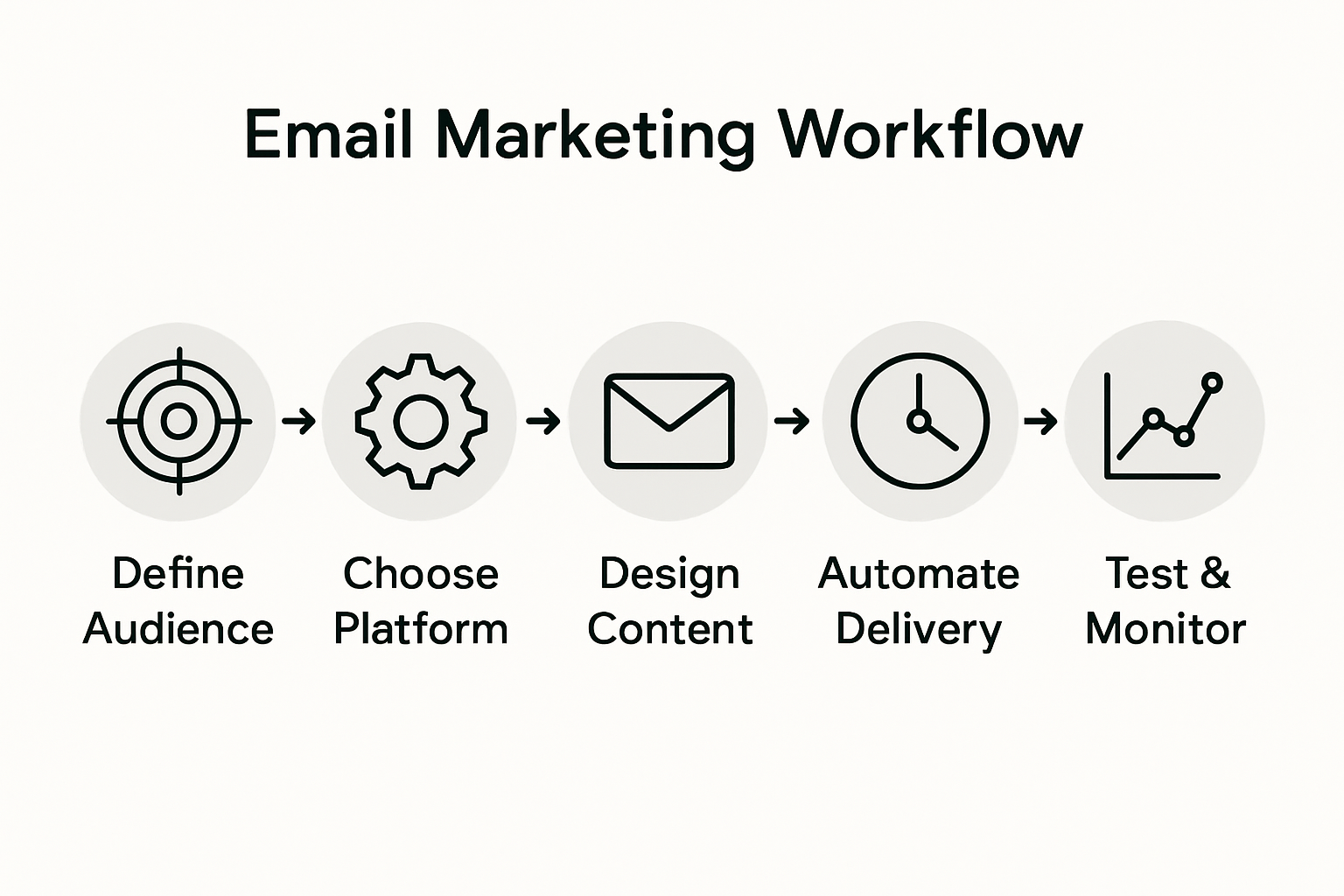
- Step 1: Define Your Audience And Campaign Goal
- Step 2: Select And Configure Your Email Platform
- Step 3: Design Engaging Email Content And Sequences
- Step 4: Automate Your Email Delivery Process
- Step 5: Test And Monitor Campaign Performance
Quick Summary
| Key Point | Explanation |
|---|---|
| 1. Define Target Audience Clearly | Create an audience profile detailing demographics, interests, and behaviours to enhance email relevance and connection. |
| 2. Choose the Right Email Platform | Evaluate platforms based on features like segmentation, automation, and analytics to ensure alignment with your campaign needs. |
| 3. Craft Engaging Email Content | Develop tailored narratives and compelling subject lines to capture subscriber attention and encourage engagement. |
| 4. Implement Smart Automation Techniques | Use customer journey mapping to automate personalised emails, enhancing the responsiveness and relevance of your communications. |
| 5. Regularly Test and Analyse Campaigns | Set up A/B testing and track key metrics to continuously refine strategies and improve email marketing performance. |
Step 1: Define your audience and campaign goal
Successful email marketing begins with pinpointing exactly who you want to reach and what specific outcome you want to achieve. By understanding your target audience and campaign objectives, you can craft messages that genuinely connect and drive meaningful results.
Start by developing a comprehensive audience profile that goes beyond basic demographics. Consider not just age and location, but also behaviour patterns, interests, challenges, and purchasing history. The University of Florida recommends creating quantitative goals that are measurable and specific. This might mean setting precise targets like generating 50 new product sign-ups, increasing engagement rates by 15%, or driving £2000 in sales from a single campaign.
To build an effective profile, compile data from multiple sources such as website analytics, customer surveys, and past purchase records. This granular understanding allows you to segment your audience and personalise content that resonates. Pro tip: Always align your campaign goal with a clear value proposition for your recipients.

As you move forward, remember that your audience definition and campaign goal will shape every subsequent decision in your email marketing workflow.
Step 2: Select and configure your email platform
Choosing the right email marketing platform can make or break your entire campaign strategy. Platform selection involves carefully evaluating multiple technical and practical considerations that will impact your marketing effectiveness and operational efficiency.
Begin by assessing your specific requirements. Look beyond basic sending capabilities and examine deeper features like audience segmentation, automation potential, integration capabilities, and comprehensive analytics reporting. Consider your budget, technical comfort level, and scalability needs. Some platforms work brilliantly for small businesses with simple requirements, while others offer complex enterprise solutions with advanced workflow management.
Prioritise platforms that offer intuitive user interfaces, robust deliverability rates, and flexible customisation options. Pay attention to pricing structures some platforms charge per email sent, while others offer unlimited sending with tiered feature access. A smart approach involves testing multiple platforms through free trials, comparing their specific features against your campaign goals, and ensuring they align with your technical infrastructure.
Remember that your email platform is not just a sending tool but a strategic partner in your marketing ecosystem. The right choice will streamline your workflow and amplify your communication effectiveness.
Step 3: Design engaging email content and sequences
Crafting compelling email content requires a strategic approach that transforms ordinary messages into powerful communication tools. Personalisation techniques play a crucial role in capturing and maintaining subscriber attention, helping you create meaningful connections with your audience.
Start by developing a comprehensive content strategy that goes beyond generic messaging. Understand your audience segments and create tailored narratives that speak directly to their specific needs and interests. The key is to balance informative content with persuasive storytelling. Compelling subject lines are your first opportunity to spark curiosity and drive open rates, so invest time in crafting concise, action oriented phrases that immediately communicate value.
Consider building email sequences that tell a progressive story. Each email should feel like a natural progression while maintaining standalone value. Mix educational content, soft promotional material, and genuine value propositions. Your goal is to create a rhythmic communication flow that keeps subscribers anticipating your next message without feeling overwhelmed.
Remember that great email content is not about selling but about building genuine relationships. Your sequences should educate, entertain, and solve real problems for your audience.
Step 4: Automate your email delivery process
Automation transforms email marketing from a manual task into a strategic, intelligent communication system. Advanced automation techniques leverage predictive analytics and intelligent scheduling to deliver precisely timed, personalised content that resonates with your audience.
Begin by mapping out comprehensive customer journey workflows that trigger emails based on specific user behaviours, interactions, and segmentation criteria. This means creating conditional logic that automatically responds to subscriber actions such as website visits, purchase history, engagement levels, and preferences. Cutting edge automation now incorporates AI powered personalisation strategies that go far beyond simple name insertion, allowing you to craft dynamic content experiences that feel uniquely tailored to each recipient.
Implement smart triggers that activate different email sequences based on precise conditions. A welcome series might automatically launch when someone subscribes, while abandoned cart reminders could trigger after a specific time period. The goal is creating a responsive system that feels both personal and timely without requiring constant manual intervention.
Remember that effective automation is not about sending more emails but delivering more relevant emails at precisely the right moment.
Step 5: Test and monitor campaign performance
Successful email marketing demands rigorous performance evaluation and continuous refinement. Comprehensive analytics and reporting are essential for understanding the nuanced dynamics of your email campaigns, providing insights that transform raw data into actionable strategies.
Begin by establishing a systematic testing framework that goes beyond surface level metrics. Implement sophisticated A/B testing protocols to evaluate different elements such as subject lines, content structure, send times, and call to action placements. Understanding common email marketing mistakes helps prevent communication failures that could compromise your campaign effectiveness, so pay close attention to metrics like open rates, click through rates, conversion rates, and subscriber engagement levels.
Utilise advanced attribution modelling to track the complete customer journey and understand how each email contributes to your broader marketing objectives. This means looking beyond immediate conversions and examining how your email sequences influence long term customer behaviour and brand perception. Configure real time reporting dashboards that provide immediate visibility into campaign performance, allowing you to make swift adjustments and optimisations.
Remember that testing is not a one time activity but a continuous process of learning, adapting, and improving your email marketing strategy.
Accelerate Your Email Marketing Success with Practical Tools
Struggling to build, automate, and optimise your email marketing workflow effectively The article highlights key challenges like defining your audience clearly, creating engaging content sequences, and automating delivery for precise timing. These pain points can feel overwhelming without the right support. That is where Marketing – Steve Pritchard Online comes in offering beginner-friendly digital products tailored to help you overcome common obstacles such as complex automation setups and content personalisation.
Start powering your email campaigns with easy to use AI tools, ready-made marketing templates, and lead-generation assets designed for everyday people with no tech headaches. Visit Steve Pritchard Online now to explore resources that save time, reduce overwhelm, and set you on a quicker path to online income. Take the next step today and transform your email marketing workflow into a streamlined success story.
Frequently Asked Questions
How do I define my audience and campaign goal for email marketing?
Successful email marketing starts by understanding exactly who you want to reach and what you aim to achieve. Develop a detailed audience profile that includes demographics, behaviour patterns, and purchasing history, and set specific, measurable goals like increasing engagement rates by 15%.
What features should I look for in an email marketing platform?
When selecting an email marketing platform, prioritise features such as audience segmentation, automation capabilities, and analytics reporting. Assess your budget and technical skills to choose a platform that meets your specific requirements and supports your campaign goals.
How can I design engaging email content?
To create compelling email content, personalise your messaging based on audience segments and develop narratives that speak directly to their interests. Focus on crafting engaging subject lines and consider using email sequences to maintain communication flow while providing standalone value in each message.
What are the benefits of automating my email delivery process?
Email automation streamlines your communication by sending timely, personalised content based on user behaviours. Map out customer journey workflows that activate automatically, such as welcome series or abandoned cart reminders, to enhance relevance without manual effort.
How do I test and monitor my email campaign performance?
Regularly evaluate your email campaigns using A/B testing to assess different components like subject lines and content structure. Establish a systematic framework for tracking performance metrics, allowing you to make data-driven adjustments that enhance engagement and conversion rates over time.