Most British businesses overlook how a well-structured promotional funnel can drive significant long-term growth. With over 85 percent of successful online marketers using some form of funnel system, it is clear that understanding the principles behind these frameworks is crucial. Knowing how to strategically guide potential customers from awareness to purchase allows both new and established entrepreneurs to turn unpredictable interest into measurable results.
Table of Contents
- What Is a Promotional Funnel? Core Principles
- Types of Promotional Funnels Explained
- How Promotional Funnels Really Work
- Key Benefits for Affiliate Marketers
- Common Pitfalls and How to Avoid Them
Key Takeaways
| Point | Details |
|---|---|
| Understanding the Promotional Funnel | A promotional funnel is a strategic framework guiding customers from awareness to purchase, requiring tailored strategies for each stage. |
| Types of Funnels | Different types of promotional funnels serve unique objectives, such as lead generation, sales, and email marketing, necessitating an understanding of customer psychology. |
| Benefits for Affiliate Marketers | Promotional funnels enhance targeting, improve conversion rates, and streamline customer acquisition, transforming traffic into predictable revenue. |
| Avoiding Common Pitfalls | Marketers must avoid poor targeting and complex designs, maintain clear messaging, and continuously optimise strategies for successful funnel management. |
What Is a Promotional Funnel? Core Principles
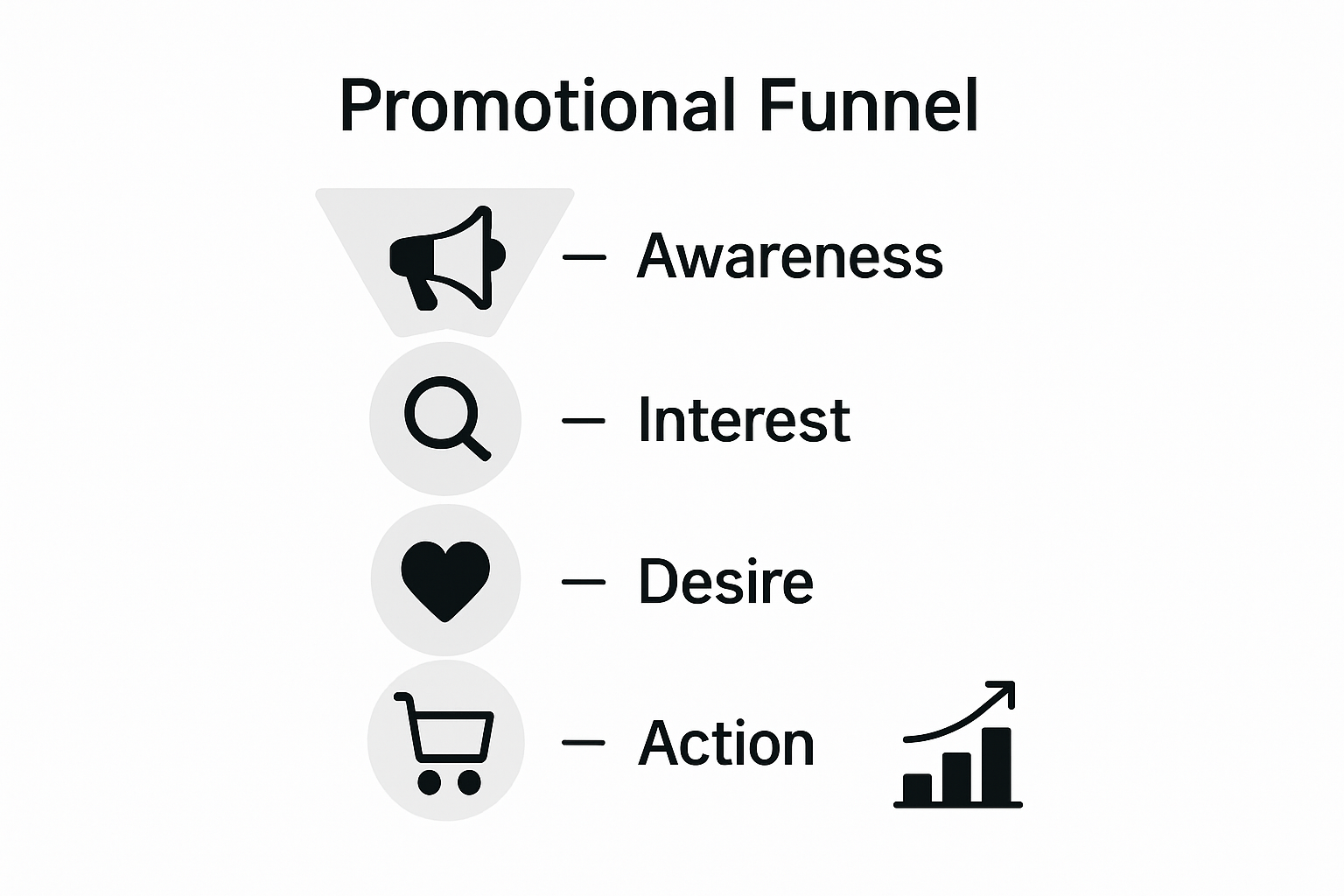
A promotional funnel represents a strategic framework designed to systematically guide potential customers through a structured journey from initial awareness to final purchase. Rooted in the purchase funnel model, this approach transforms casual prospects into committed buyers by carefully mapping out each interaction and psychological transition.
The core architecture of a promotional funnel typically encompasses four fundamental stages that mirror human decision-making processes:
- Awareness Stage: Introducing potential customers to your product or service
- Interest Stage: Generating curiosity and establishing initial engagement
- Desire Stage: Creating emotional connection and perceived value
- Action Stage: Facilitating the final conversion and purchase decision
Marketing professionals understand that each stage requires unique strategies and targeted communications. Successful promotional funnels anticipate customer psychology, addressing specific concerns and motivations while progressively building trust. By crafting tailored experiences that respond to evolving customer needs, entrepreneurs can dramatically increase conversion rates and build sustainable revenue streams.
The most effective promotional funnels are not rigid structures but adaptive systems. They leverage data insights, personalisation techniques, and strategic touchpoints to guide potential customers seamlessly from initial curiosity to committed purchasing behaviour. Whether you are selling digital products, physical goods, or services, understanding and implementing a well-designed promotional funnel can transform your marketing approach from scattered attempts to a precision-engineered revenue generation mechanism.
Types of Promotional Funnels Explained
Promotional funnels are not one-size-fits-all strategies, but rather diverse approaches tailored to specific marketing objectives. Different marketing funnels serve unique purposes, enabling entrepreneurs to design targeted customer journeys that maximise conversion potential across various business models.
Key types of promotional funnels include:
- Lead Generation Funnel: Focuses on capturing potential customer contact information
- Sales Funnel: Designed to guide prospects directly towards purchasing a product
- Webinar Funnel: Utilises educational content to build trust and credibility before selling
- Product Launch Funnel: Creates anticipation and excitement around new product releases
- Email Marketing Funnel: Nurtures relationships through strategic email communication sequences
Each funnel type requires sophisticated understanding of customer psychology and strategic touchpoint design. Successful implementation demands precise mapping of customer interactions, understanding pain points, and crafting compelling messaging that resonates with specific audience segments. The most effective marketers recognise that flexibility is crucial, often blending multiple funnel approaches to create comprehensive engagement strategies.
Choosing the right promotional funnel depends on multiple factors, including product complexity, target audience characteristics, and specific business goals. Entrepreneurs must analyse their unique market positioning, customer behaviours, and conversion objectives to select and customise the most appropriate funnel strategy. By understanding the nuanced differences between these funnel types, digital marketers can develop more intelligent, responsive, and ultimately more profitable customer acquisition systems.

How Promotional Funnels Really Work
At its core, a promotional funnel is a sophisticated psychological journey that transforms casual browsers into committed customers. The purchase funnel illustrates how marketers systematically guide potential buyers through increasingly focused stages of engagement, carefully managing emotional and rational decision-making processes.
The operational mechanics of a promotional funnel can be broken down into critical stages:
- Attraction: Drawing potential customers into your initial sphere of influence
- Engagement: Creating meaningful interactions that build curiosity
- Evaluation: Helping prospects assess the value and relevance of your offering
- Conversion: Facilitating the final decision to purchase
- Retention: Nurturing ongoing relationships beyond the initial transaction
Successful promotional funnels operate like precision instruments, using carefully crafted psychological triggers and strategic communication touchpoints. Each interaction is meticulously designed to address specific customer concerns, overcome potential objections, and gradually build trust. The most effective marketers understand that movement through the funnel is not linear but requires constant refinement, personalisation, and responsive communication.
Technically, promotional funnels leverage multiple communication channels and data insights to create adaptive customer experiences. By tracking user behaviours, analysing engagement metrics, and continuously optimising messaging, entrepreneurs can develop increasingly sophisticated strategies that transform cold leads into loyal customers. The real magic of a promotional funnel lies not just in its ability to drive sales, but in its capacity to create meaningful, value-driven connections that transcend traditional transactional relationships.
Key Benefits for Affiliate Marketers
Affiliate marketers discover remarkable advantages when implementing strategic promotional funnels. Marketing funnels offer substantial benefits by transforming random website traffic into systematic, predictable revenue streams that maximise conversion potential.
Key benefits for affiliate marketers include:
- Predictable Income: Creating reliable, repeatable sales processes
- Enhanced Targeting: Precisely identifying and engaging ideal customer segments
- Improved Conversion Rates: Systematically guiding prospects through purchasing decisions
- Performance Tracking: Measuring and optimising each stage of customer interaction
- Reduced Customer Acquisition Costs: Streamlining marketing efforts for maximum efficiency
Successful affiliate marketers understand that promotional funnels are not merely sales mechanisms, but sophisticated psychological frameworks. Each funnel stage represents an opportunity to build trust, demonstrate value, and address potential customer hesitations. By crafting meticulously designed communication pathways, marketers can transform casual browsers into committed purchasers, creating value for both customers and themselves.
The true power of promotional funnels lies in their ability to convert complex, multi-stage purchasing journeys into structured, manageable processes. Advanced affiliate marketers leverage data-driven insights, personalisation techniques, and strategic communication to develop funnels that adapt dynamically to changing customer behaviours. This approach transforms traditional marketing from a hit-or-miss endeavour into a precise, repeatable system for generating sustainable online income.
Common Pitfalls and How to Avoid Them
Promotional funnels can be powerful marketing tools, but many affiliate marketers stumble into predictable traps that undermine their potential success. Unlocking your affiliate superpowers requires understanding and navigating these critical challenges with strategic precision.
Common pitfalls that can derail promotional funnels include:
- Poor Audience Targeting: Casting too wide a marketing net
- Insufficient Value Proposition: Failing to communicate unique product benefits
- Complex Funnel Design: Creating overly complicated customer journeys
- Inadequate Follow-up: Neglecting post-purchase customer relationships
- Inconsistent Messaging: Sending mixed signals across different marketing channels
Successful marketers recognise that avoiding these pitfalls demands continuous learning and adaptive strategies. Each potential mistake represents an opportunity to refine your approach, understanding that promotional funnels are dynamic systems requiring constant optimisation. The most effective affiliate marketers treat their funnels as living mechanisms, continuously testing, measuring, and adjusting their strategies based on real-world performance data.
Prevention requires a proactive mindset. By implementing rigorous tracking mechanisms, maintaining crystal-clear communication, and remaining committed to delivering genuine value, entrepreneurs can transform potential pitfalls into strategic advantages. The key lies not in avoiding mistakes entirely, but in developing the resilience and analytical skills to quickly identify, understand, and rectify any emerging challenges in your promotional funnel strategy.
Harness the Power of Promotional Funnels with Practical Tools
Understanding and implementing promotional funnels can feel overwhelming, especially for beginners facing challenges such as poor audience targeting or complex funnel designs. This article highlights key pain points like navigating each funnel stage, creating effective engagement, and avoiding common pitfalls. If you want to turn these concepts like lead generation and sales funnels into actual, repeatable income without the usual tech headaches, you need support designed for everyday people.
At Steve Pritchard Online, we provide practical, beginner-friendly digital products including AI-powered content tools, marketing templates, and affiliate marketing resources that help you build and optimise your promotional funnels quickly. Whether you’re looking to automate your income or create targeted campaigns that convert, our range of solutions takes the guesswork out of funnel creation and customer engagement.
Start Your Funnel Journey Today
Take control of your online income by using tools that simplify the entire funnel process. Stop feeling overwhelmed and start building predictable revenue streams right away with easy-to-follow resources. Visit Steve Pritchard Online Shop now and discover how straightforward profitable funnels can be.
Frequently Asked Questions
What are the main stages of a promotional funnel?
The main stages of a promotional funnel typically include Awareness, Interest, Desire, and Action. These stages guide potential customers through a structured journey, starting from initial awareness of a product or service to the final purchase decision.
How do promotional funnels increase conversion rates?
Promotional funnels increase conversion rates by strategically guiding prospects through various stages of engagement, addressing specific concerns, and building trust. They leverage targeted communications that resonate with customer psychology, ultimately leading to higher likelihood of purchase.
What types of promotional funnels are commonly used?
Common types of promotional funnels include Lead Generation Funnels, Sales Funnels, Webinar Funnels, Product Launch Funnels, and Email Marketing Funnels. Each type serves unique marketing objectives and is tailored to engage customers effectively.
What common mistakes should I avoid when creating a promotional funnel?
Common mistakes to avoid include poor audience targeting, insufficient value propositions, overly complex funnel designs, inadequate follow-up with customers, and inconsistent messaging across marketing channels. Addressing these pitfalls can enhance the effectiveness of your promotional funnel.