Most advice about affiliate marketing overlooks how many british entrepreneurs fall for common myths. Many jump in thinking they will earn easy money, yet the reality involves far more strategy and dedication. In fact, only about 15 percent of affiliate marketers generate meaningful income. Understanding what truly works and which pitfalls to avoid gives you a real edge, especially if you want your marketing efforts to turn into lasting results.
Table of Contents
- Affiliate Marketing Defined And Misconceptions
- Main Types Of Affiliate Programmes Explained
- How Affiliate Marketing Generates Income
- Getting Started: Skills And Tools Needed
- Common Pitfalls And How To Avoid Them
Key Takeaways
| Point | Details |
|---|---|
| Affiliate Marketing Requires Effort | Contrary to misconceptions, achieving success in affiliate marketing necessitates consistent effort and strategic planning. |
| Diverse Affiliate Programme Types | Understanding different compensation models, such as pay-per-sale and pay-per-lead, is crucial for optimising income potential. |
| Essential Skills for Success | Key skills include digital marketing expertise, content creation, and data analysis to drive effective promotional strategies. |
| Avoiding Common Pitfalls | Maintain transparency with your audience and diversify marketing channels to mitigate risks associated with relying on a single traffic source. |
Affiliate Marketing Defined and Misconceptions
Affiliate marketing is a dynamic performance-based marketing strategy where individuals earn commissions by promoting other companies’ products or services. Unlike traditional advertising, this approach rewards marketers based on actual sales or specific actions generated through their unique promotional channels. Tracking performance metrics allows businesses to precisely measure the effectiveness of their marketing partnerships.
Many aspiring marketers harbour misconceptions about this business model. The primary myth is that affiliate marketing represents an effortless path to passive income. In reality, successful affiliate marketing demands strategic planning, consistent effort, and a nuanced understanding of digital marketing principles. Contrary to popular belief, it is not a ‘get-rich-quick’ scheme but a legitimate professional marketing approach requiring dedication and skill.
The core mechanism of affiliate marketing involves three primary participants: the merchant (product creator), the affiliate (promoter), and the consumer. Affiliates receive unique tracking links that record every sale or action they generate. Commissions are typically calculated as a percentage of the total sale value, ranging from 5% to 50% depending on the product and industry. This transparent, performance-driven model ensures that marketers are directly rewarded for their promotional efforts.
Pro Tip: Strategic Selection Strategy: Focus on promoting products you genuinely understand and believe in, as authenticity significantly increases conversion rates and builds long-term audience trust.
Main Types of Affiliate Programmes Explained
Affiliate marketing programmes represent diverse compensation models that enable marketers to earn income through strategic online promotions. Different programme structures offer unique opportunities for digital entrepreneurs to monetise their online presence and marketing efforts.
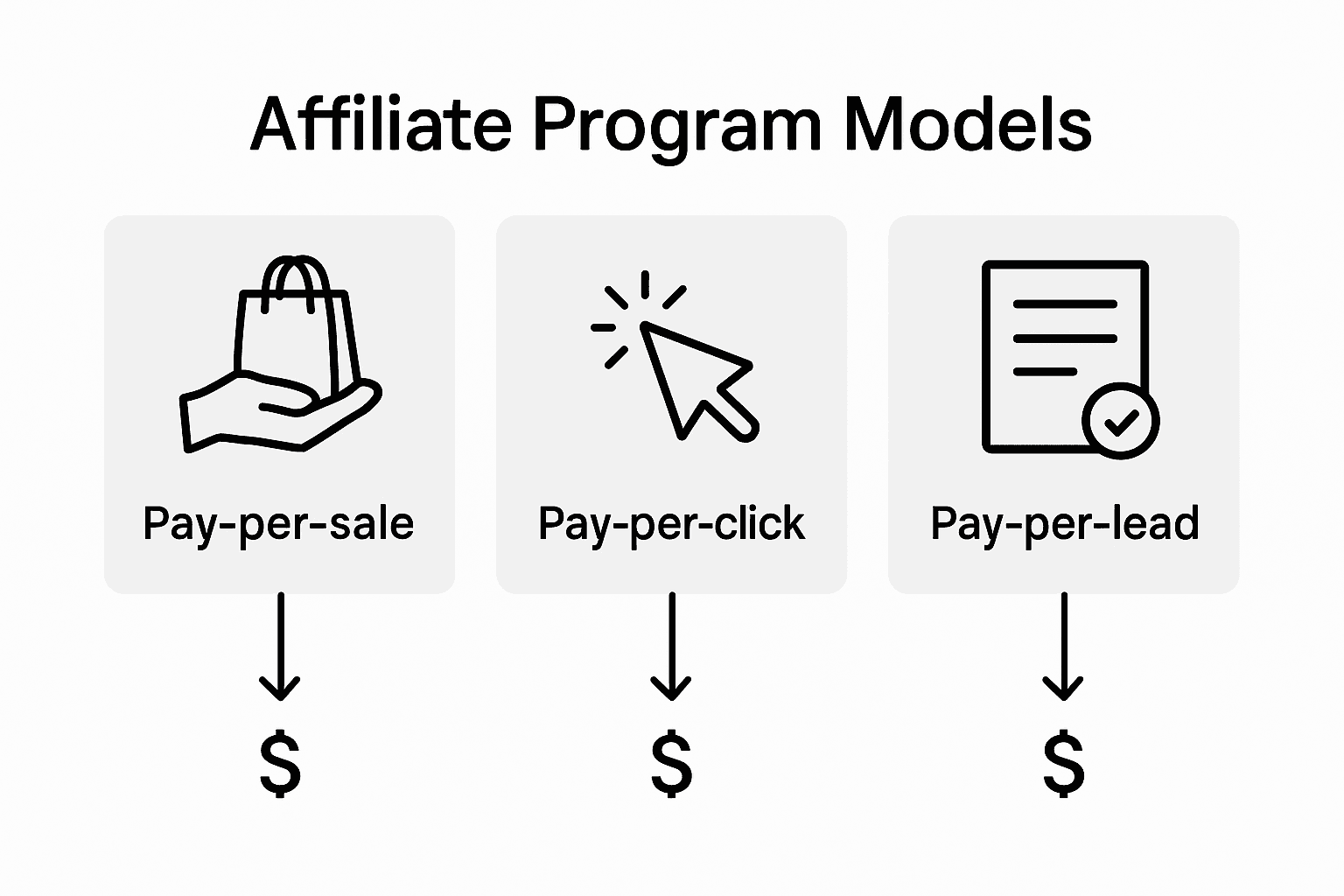
The primary affiliate programme types include pay-per-sale, pay-per-click, and pay-per-lead models. Pay-per-sale programmes reward affiliates with a percentage commission when a customer completes a purchase through their unique tracking link. Pay-per-click programmes compensate marketers based on the number of clicks generated, regardless of whether a sale occurs. Pay-per-lead models provide commissions for generating potential customer contacts or sign-ups for the merchant.
Cost-per-action (CPA) and cost-per-click (CPC) models offer nuanced approaches to affiliate compensation. CPA programmes provide payments when specific actions are completed, such as form submissions or app downloads. These structures allow affiliates to select programmes that best align with their audience engagement strategies and content creation approaches.
Here is a comparison of the main affiliate programme types and their typical business impacts:
| Programme Type | How Affiliates Earn | Example Actions | Business Impact |
|---|---|---|---|
| Pay-per-sale | Commission on completed sales | Product purchase | Drives direct sales growth |
| Pay-per-click | Payment per generated click | Ad click, link click | Increases web traffic |
| Pay-per-lead | Commission per qualified lead | Email sign-up, form filled | Expands potential customer base |
| Cost-per-action | Payment for set action | App download, survey completion | Targets specific conversions |
Pro Tip: Programme Selection Strategy: Carefully analyse your audience’s interests and behaviours to choose affiliate programmes with commission structures and products that naturally resonate with your existing content and followers.
How Affiliate Marketing Generates Income
Affiliate marketing represents a dynamic income generation model where digital entrepreneurs monetise their online platforms by strategically promoting third-party products. Income generation mechanisms are fundamentally performance-based, rewarding marketers for driving tangible commercial outcomes like sales, leads, or website traffic.
The primary income streams in affiliate marketing emerge through several compensation structures. Percentage-based commissions remain the most prevalent, where affiliates earn a predetermined percentage of each successful sale they generate. Typical commission rates range from 5% to 50%, depending on the product complexity, industry, and merchant’s pricing strategy. Some digital products, particularly software and information resources, offer exceptionally high commission rates, sometimes exceeding 70% of the product’s total value.

Commission structures vary significantly across different sectors and marketing platforms. Digital marketers can leverage multiple income channels simultaneously, such as combining pay-per-sale programmes with cost-per-action campaigns. This diversified approach allows affiliates to maximise their earning potential by targeting different audience segments and promotional strategies.
Pro Tip: Income Optimisation Strategy: Continuously track your conversion rates and commission earnings, focusing on promoting products that demonstrate consistently high performance and align closely with your audience’s specific interests and needs.
Getting Started: Skills and Tools Needed
Affiliate marketing demands a sophisticated blend of digital skills and strategic technological resources. Essential competencies for success encompass digital marketing expertise, content creation capabilities, and analytical thinking that transforms audience interactions into measurable commercial outcomes.
Key skills required include search engine optimisation (SEO), compelling content writing, audience engagement strategies, and data interpretation. Digital marketers must develop proficiency in understanding audience demographics, crafting persuasive narratives, and tracking performance metrics. Technical capabilities like website development, social media management, and basic graphic design provide additional competitive advantages in creating attractive, conversion-focused promotional content.
Strategic marketing tools play a critical role in streamlining affiliate marketing efforts. Recommended technological resources include analytics platforms, keyword research software, email marketing systems, and social media scheduling tools. These technologies enable precise audience targeting, performance tracking, and automated marketing workflows that significantly enhance efficiency and potential revenue generation.
Below is a summary of essential digital skills and strategic tools for affiliate marketing success:
| Skill or Tool | Description | Why It Matters |
|---|---|---|
| SEO | Improves search ranking | Increases organic audience reach |
| Content Creation | Develops engaging material | Attracts and converts visitors |
| Analytics Platform | Tracks metrics and conversions | Informs data-driven decisions |
| Social Media Scheduler | Automates content distribution | Saves time, maintains consistency |
| Email Marketing System | Manages contact lists and campaigns | Nurtures long-term relationships |
Pro Tip: Skill Development Strategy: Invest consistently in learning new digital marketing techniques and experiment with emerging technologies, allocating at least two hours weekly to structured skill enhancement and practical implementation of new marketing approaches.
Common Pitfalls and How to Avoid Them
Affiliate marketing presents numerous challenges that can derail even the most promising digital marketing strategies. Ethical marketing practices form the cornerstone of sustainable success, with potential pitfalls ranging from regulatory non-compliance to reputation-damaging promotional techniques.
One of the most critical mistakes affiliate marketers make is failing to maintain transparency with their audience. This includes not disclosing affiliate relationships, which can erode audience trust and potentially violate legal guidelines. Marketers should always clearly communicate their affiliate status, ensuring that promotional content remains honest and genuine. Additionally, over-reliance on a single traffic source or marketing channel can create significant vulnerability, limiting potential reach and income potential.
Marketing channel diversification represents a crucial strategy for mitigating risk and maximising affiliate marketing potential. Successful marketers spread their promotional efforts across multiple platforms, including social media, email marketing, content blogs, and targeted advertising. This approach not only protects against sudden algorithm changes or platform restrictions but also allows for more comprehensive audience engagement and multiple revenue streams.
Pro Tip: Risk Management Strategy: Develop a comprehensive compliance checklist that includes affiliate disclosure requirements, platform-specific guidelines, and ethical marketing practices, reviewing and updating it quarterly to stay current with evolving digital marketing standards.
Unlock Your Affiliate Marketing Potential with Practical Tools
Affiliate marketing can be complex and overwhelming, especially when starting out or trying to grow your online income effectively. You may be facing challenges such as choosing the right programmes, mastering essential digital skills, or finding authentic products to promote—all crucial for building trust and earning commissions consistently. This is where having straightforward, beginner-friendly resources tailored to your needs makes all the difference.

Discover how Marketing – Steve Pritchard Online provides clear strategies and easy-to-use digital products designed to help you automate and scale your affiliate marketing efforts. Whether you need AI-powered content tools, lead-generation assets, or quick-start kits, our selections are created with everyday people in mind. Start reducing overwhelm and eliminate tech headaches by accessing practical solutions that accelerate your earning potential today at Steve Pritchard Online. Take control of your affiliate marketing journey now and turn your hard work into real, measurable income.
Frequently Asked Questions
What is affiliate marketing?
Affiliate marketing is a performance-based marketing strategy where individuals earn commissions by promoting other companies’ products or services. Marketers are rewarded based on actual sales or specific actions generated through their unique promotional channels.
How do affiliates earn commissions in affiliate marketing?
Affiliates can earn commissions through various program types, including pay-per-sale, pay-per-click, and pay-per-lead models. Earnings depend on the actions taken by consumers, such as making purchases, clicking links, or signing up for services.
What skills are necessary for successful affiliate marketing?
Successful affiliate marketing requires skills in digital marketing, content creation, SEO, audience engagement, and data interpretation. Technical capabilities, such as website development and social media management, also enhance promotional efforts.
What are common pitfalls to avoid in affiliate marketing?
Common pitfalls include failing to maintain transparency with your audience regarding affiliate relationships, over-reliance on a single traffic source, and not diversifying marketing channels. These mistakes can erode trust and limit potential reach and income.