Most beginner affiliate marketers underestimate how much a well-crafted email sequence can transform digital product sales. Even a british newcomer can see real results quickly when strategy replaces guesswork. With over 60 percent of online revenue driven by effective email marketing sequences, learning easy, actionable steps has never been more important. This guide unpacks fuss-free methods that help you connect with your audience, personalise messages, and watch your affiliate earnings grow without complex technical setups.
Table of Contents
- Step 1: Define Your Affiliate Offer And Target Audience
- Step 2: Select And Configure Your Email Platform
- Step 3: Create Compelling Email Sequence Content
- Step 4: Automate Sequence Delivery And Timing
- Step 5: Test Your Sequence Before Launching
- Step 6: Monitor Results And Optimise Campaigns
Quick Summary
| Key Takeaway | Explanation |
|---|---|
| 1. Define target audience clearly | Understanding your audience’s demographics and preferences is essential for effective marketing. |
| 2. Choose the right email platform | Select an email platform with automation, segmentation, and analytics features to enhance campaigns. |
| 3. Create engaging email sequences | Develop email content that addresses audience pain points and provides value beyond product promotion. |
| 4. Automate for timely delivery | Use automation to ensure emails are sent at optimal times based on subscriber behaviours. |
| 5. Continuously monitor and optimise | Regularly analyse key performance metrics to refine your email campaigns and improve engagement. |
Step 1: Define your affiliate offer and target audience
Successful affiliate marketing begins with crystal clear targeting. You need a laser-focused understanding of both your product and the precise audience most likely to purchase it.
Defining your target audience involves strategic demographic analysis. The most effective affiliates understand that precise targeting is not just about numbers but about understanding consumer lifestyles and preferences. This means diving deep into demographic characteristics such as age, income level, professional background, online behaviour, and specific interests related to your affiliate product. For instance, if you are promoting digital marketing tools, your target audience might be young entrepreneurs between 25-40 years old, working in technology or creative industries, with an annual income above £40,000 and a demonstrated interest in scaling online businesses.
When selecting your affiliate offer, align it meticulously with your audience’s needs and pain points. Affiliate marketing enables precise targeting of specific demographic groups which means you can craft highly personalised marketing messages that resonate deeply. Consider factors like product relevance, commission structure, brand reputation, and potential customer lifetime value.
Advanced tip: Create a detailed customer persona document that includes demographic details, online behaviour patterns, preferred communication channels, and potential objections to purchasing. This living document will transform your affiliate marketing strategy from generic to exceptional.
Top tip: Research and validate your target audience through actual market data rather than assumptions. Use tools like Google Analytics, social media insights, and audience survey platforms to build a robust understanding of your potential customers.
Step 2: Select and configure your email platform
Chosing the right email platform represents a critical foundation for your affiliate marketing success. Your selected platform will determine how effectively you communicate with potential customers and manage your marketing campaigns.

Choosing the right email platform is crucial for affiliate marketers, as it must offer robust features that support your marketing objectives. Look for platforms that provide comprehensive automation capabilities, advanced segmentation tools, and detailed analytics dashboards. Key considerations include integration potential with your existing affiliate tracking systems, ease of use, pricing structure, and scalability. Popular options like Mailchimp, ConvertKit, and ActiveCampaign offer different strengths depending on your specific affiliate marketing requirements.
Configuring your email platform involves setting up automated workflows that streamline your marketing processes. This means creating email sequences, setting up trigger-based communications, and establishing segments that allow personalised messaging. Ensure your chosen platform supports key functionalities such as split testing, subscriber tagging, and comprehensive reporting to track campaign performance.
Advanced tip: Create multiple email templates with different messaging styles to test audience engagement and optimise your conversion rates.
Professional tip: Always conduct a thorough trial period with your selected email platform, testing all critical features before committing to a long term subscription.
Here is a comparison of key considerations when selecting an email platform for affiliate marketing:
| Consideration | Importance for Affiliates | Typical Business Impact |
|---|---|---|
| Automation Features | Enables hands-off campaign flow | Saves time, increases efficiency |
| Segmentation Tools | Targets specific audience groups | Improves relevance and engagement |
| Analytics Dashboard | Tracks performance metrics | Informs data-driven decisions |
| Integration Options | Works with other systems | Streamlines affiliate management |
| Scalability | Accommodates business growth | Supports long-term expansion |
| Pricing Structure | Affects overall ROI | Avoids excessive costs |
Step 3: Create compelling email sequence content
Crafting an effective email sequence demands strategic thinking and a deep understanding of your audience’s psychological triggers. Your email content will be the critical bridge between audience interest and potential conversion.
Developing engaging email content requires understanding your audience’s needs and interests. This means constructing messages that transcend simple product promotion and instead focus on providing genuine value. Your email sequence should tell a story that resonates with your target demographic, addressing their specific pain points and demonstrating how your recommended product offers a meaningful solution. Each email must feel personalised, almost as if you are speaking directly to an individual rather than broadcasting to a mass audience.
Effective email sequences should include a mix of informative and promotional content, maintaining a delicate balance that nurtures subscriber relationships while subtly driving conversions. Typically, this means designing a sequence that follows a strategic progression. Start with educational content that establishes your credibility, then gradually introduce product recommendations, interspersed with social proof, customer testimonials, and compelling case studies that demonstrate real world value. Your goal is to build trust progressively, transforming cold prospects into engaged potential customers who view your recommendations as helpful guidance rather than aggressive sales pitches.
Advanced tip: Develop a detailed content matrix that maps out the emotional journey and informational progression of your email sequence before you begin writing.
Professional tip: Always craft your emails as though you are writing to a single, specific person in your target audience, which will help maintain an authentic and personalised tone.
Step 4: Automate sequence delivery and timing
Automating your email sequence represents the backbone of efficient affiliate marketing. By implementing strategic automation, you transform manual communication into a precisely calibrated marketing machine that delivers the right message at the perfect moment.
Utilising automation tools within your email platform allows for timely and consistent delivery of your email sequences, ensuring messages reach subscribers at optimal times. This means configuring detailed workflows that trigger emails based on specific subscriber interactions. Consider creating time-based delays between emails to prevent overwhelming your audience, typically spacing communications 2-3 days apart. Some platforms offer advanced features like sending emails according to the subscriber’s local time zone, which can significantly improve open rates and engagement.
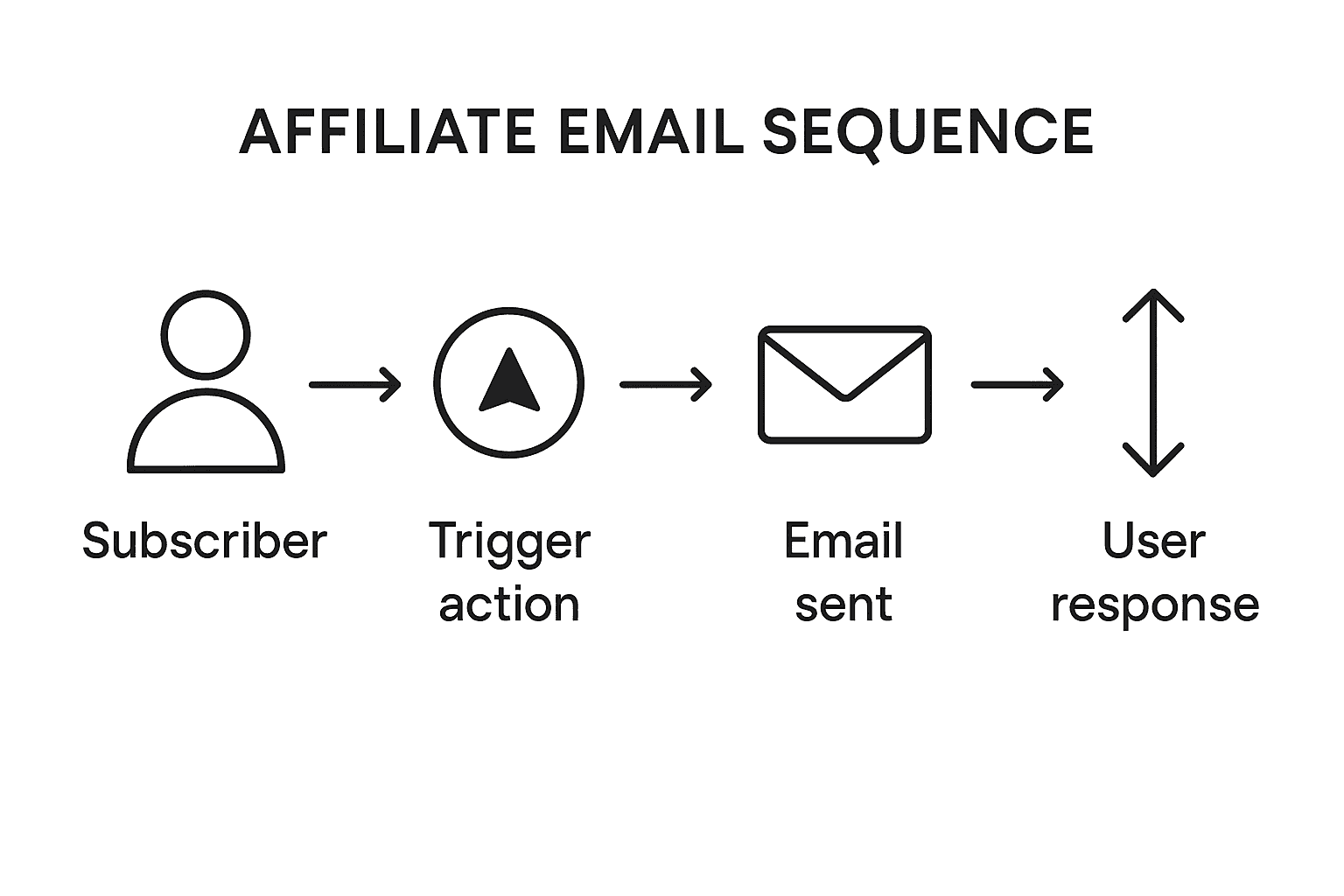
Setting up automated triggers based on subscriber actions can dramatically enhance engagement and campaign effectiveness. These triggers might include sending a follow-up email when a subscriber clicks a specific link, downloads a resource, or demonstrates interest in a particular product category. By mapping out these behavioural pathways, you create a dynamic communication system that responds intelligently to individual subscriber interactions, making each recipient feel uniquely understood.
Advanced tip: Create multiple automation pathways with branching logic that adapts to different subscriber behaviours and engagement levels.
Professional tip: Regularly audit and optimise your automation sequences, tracking key metrics like open rates, click-through rates, and conversion performance to continually refine your approach.
Step 5: Test your sequence before launching
Launching an untested email sequence is like navigating uncharted waters without a compass. Comprehensive testing serves as your strategic safeguard, ensuring your meticulously crafted marketing approach performs exactly as intended.
Before launching, conduct thorough testing of your email sequences to identify and fix any issues, ensuring all links work correctly and content displays properly across devices. This means systematically reviewing each email in your sequence through multiple lenses. Start by checking technical functionality test sending emails to different email clients desktop applications, mobile devices, and webmail platforms to confirm consistent rendering. Verify that hyperlinks are correctly configured, images load seamlessly, and formatting remains intact across various screen sizes and email programmes.
A/B testing different subject lines, content formats, and sending times can provide valuable insights into what resonates best with your audience. Create multiple variations of your email sequence and test them with small, segmented subscriber groups. Analyse key performance metrics such as open rates, click through rates, and conversion percentages. Pay close attention to how different subject lines, email lengths, and content styles impact subscriber engagement. This data driven approach allows you to refine your sequence incrementally, transforming potential weaknesses into strategic strengths before your full campaign launch.
Advanced tip: Create a comprehensive testing checklist that covers technical functionality, content quality, and performance metrics to ensure no detail is overlooked.
Professional tip: Always include a test group of colleagues or trusted subscribers who can provide honest feedback about the clarity, appeal, and effectiveness of your email sequence.
Step 6: Monitor results and optimise campaigns
Campaign monitoring transforms raw data into actionable insights that fuel your affiliate marketing success. Understanding your performance metrics is not just about tracking numbers but interpreting the story behind those figures.
Successful campaign optimisation requires a comprehensive approach to analysing your email sequence performance. Track key performance indicators including open rates, click through rates, conversion percentages, and revenue generated. Most email marketing platforms provide sophisticated dashboards that break down these metrics, allowing you to understand precisely how each email in your sequence performs. Pay particular attention to which emails generate the highest engagement and which might be underperforming. Look for patterns in subscriber behaviour such as the times when emails are most frequently opened, the types of subject lines that attract the most attention, and the content that drives the most clicks.
Implementing a continuous improvement cycle is crucial for long term affiliate marketing success. This means regularly reviewing your campaign data and making incremental adjustments. Segment your audience based on their interaction levels create separate strategies for highly engaged subscribers versus those showing less interest. Consider testing different email elements such as subject lines, content length, call to action placement, and visual design. Be prepared to experiment and pivot your approach based on the insights you gather. Remember that optimisation is an ongoing process not a one time event.
Advanced tip: Develop a quarterly review framework that comprehensively analyses your email sequence performance across multiple dimensions.
Professional tip: Use data visualisation tools to help you quickly identify trends and insights that might be hidden in raw numerical data.
This summary highlights the main metrics to monitor for optimising affiliate email campaigns:
| Metric | What It Reveals | How to Use the Data |
|---|---|---|
| Open Rate | Subject line effectiveness | Refine headlines and timings |
| Click-Through Rate | Engagement with content | Adjust links and CTAs |
| Conversion Rate | Purchase/goal completion rate | Identify high-performing emails |
| Revenue Generated | Direct monetary results | Evaluate overall campaign ROI |
| Unsubscribe Rate | Audience disengagement level | Review frequency and content |
Master Your Affiliate Email Sequences with Proven Tools and Templates
Setting up an effective email sequence is one of the biggest challenges affiliate marketers face. From defining the right audience to crafting personalised content and automating delivery timing, it can quickly become overwhelming. This article breaks down the essential steps for success, highlighting critical pain points like automation setup, content optimisation, and campaign testing that can stall your progress without the right support.
If you want to stop struggling with complicated setups and endless trial and error, explore practical solutions at Marketing – Steve Pritchard Online.
Take control of your affiliate marketing journey today by accessing beginner-friendly email templates, automation guides, and lead-generation assets designed to save you time and improve your conversions. Visit Steve Pritchard Online now and discover how simple building your digital income stream can be. Don’t let technical hurdles slow you down – start growing your affiliate business with confidence using proven resources from our shop.
Frequently Asked Questions
How do I define my target audience for affiliate email sequences?
To define your target audience, focus on their demographics like age, income level, and online behaviour. Create customer personas that outline these characteristics to tailor your email content effectively.
What key features should my email platform have for affiliate marketing?
Your email platform should offer automation capabilities, segmentation tools, and detailed analytics. Ensure it can integrate seamlessly with your affiliate tracking systems to enhance your marketing efforts.
How can I create compelling content for my email sequences?
Craft engaging email content by focusing on your audience’s needs and pain points. Structure your emails to provide value, mixing informative and promotional content to maintain reader interest and gradually introduce product recommendations.
What are the best practices for automating my email sequence delivery?
Automate your email sequence by setting up workflows that trigger messages based on subscriber actions. Schedule emails with time-based delays of 2-3 days to build anticipation without overwhelming your audience.
How do I test my email sequence before launching?
Test your email sequence by sending it to different devices and email platforms to check for display issues. Conduct A/B testing on elements like subject lines and content formats to identify what resonates best with your audience.
What metrics should I monitor to optimise my email campaigns?
Monitor key metrics such as open rates, click-through rates, and conversion rates to assess your email campaign performance. Regularly review this data to make informed adjustments and enhance engagement over time.
Recommended
- Unleash Your Affiliate Superpowers with AI
- Products – AI-Powered Marketing Tools | Steve Pritchard Online
- PromoBlitz – AI-Powered Affiliate Content Generator | Steve Pritchard Online
- Sales Page – Steve Pritchard Online
- LeadLx Blog: LinkedIn Outreach, CRM Efficiency & Insights
- Klick-Tipp E-Mail-Marketing: Effektive Strategien zur Kundenbindung und Umsatzsteigerung – nova.02:media