Most aspiring affiliate marketers are surprised to learn that nearly 49 percent of worldwide sales now come directly from affiliate channels, with british professionals leading innovation across Europe. Staying ahead is not just about picking the hottest products—it is about adapting to new trends, smart technology, and shifting compliance demands. This guide breaks down the major 2025 changes that will help you tap into profitable revenue streams while navigating the global affiliate space with confidence.
Table of Contents
- Affiliate Marketing In 2025 Explained
- Major Affiliate Models And Variations
- Emerging Technologies Shaping Affiliate Success
- Compliance, Transparency, And Legal Shifts
- Avoiding Common Affiliate Mistakes In 2025
Key Takeaways
| Point | Details |
|---|---|
| Projected Growth | The affiliate marketing sector is expected to expand from $17.42 billion in 2025 to $71.74 billion by 2034, with a CAGR of 15.2%. |
| Technological Integration | Utilising advanced technologies like AI and machine learning will enhance targeting and optimisation in affiliate marketing. |
| Compliance and Transparency | Marketers must adopt rigorous compliance and transparency practices to meet global data privacy regulations and maintain consumer trust. |
| Affiliation Models | Understanding various affiliate compensation models is crucial for aligning marketing strategies with business objectives. |
Affiliate Marketing in 2025 Explained
Affiliate marketing continues to evolve as a powerful digital revenue strategy, with global market projections indicating substantial growth. Recent market research demonstrates that the affiliate marketing sector is expected to expand from $17.42 billion in 2025 to an impressive $71.74 billion by 2034, representing a robust compound annual growth rate of 15.2%.
The landscape of affiliate marketing in 2025 will be characterised by significant technological advancements and strategic shifts. Performance-based marketing strategies are becoming increasingly sophisticated, with artificial intelligence and data analytics playing crucial roles in targeting and optimisation. Notably, industry statistics reveal that approximately 49% of sales are now attributed directly to affiliate channels, and 37% of businesses are actively increasing their affiliate marketing budgets.
Key trends emerging in 2025 include the rise of niche-specific affiliate programmes, enhanced personalisation through machine learning algorithms, and greater transparency in affiliate partnerships. Content creators and marketers will need to focus on building genuine relationships with audiences, delivering authentic recommendations, and leveraging advanced tracking technologies to demonstrate clear value to both brands and consumers.
Pro Tip: Strategic Precision: Develop a hyper-targeted approach by selecting affiliate programmes that align precisely with your specific audience’s interests and needs, focusing on quality over quantity in your promotional efforts.
Pro Tip: Technology Integration: Leverage AI-powered content generation tools to streamline your affiliate marketing workflow and create more compelling, personalised promotional content efficiently.
Major Affiliate Models and Variations
Affiliate marketing encompasses diverse compensation models that enable businesses and content creators to structure their partnerships strategically. Industry research demonstrates that the current market breaks down into three primary revenue models: cost per sale (CPS) representing 52% of affiliate transactions, cost per lead (CPL) accounting for 31%, and cost per click (CPC) comprising 17% of affiliate marketing approaches.
The cost per sale (CPS) model remains the most prevalent and attractive option for businesses seeking direct revenue generation. In this framework, affiliates earn a percentage commission only when a confirmed sale occurs through their unique tracking link. This model provides maximum risk mitigation for advertisers, as payment is strictly contingent upon actual revenue generation. Market statistics indicate that CPS continues to be the preferred model due to its performance-driven nature and clear financial accountability.

Alternative models like cost per lead (CPL) and cost per click (CPC) offer different strategic advantages. CPL compensates affiliates for generating potential customer contacts, while CPC rewards traffic generation, providing more flexibility for marketers with varied campaign objectives. Each model presents unique benefits: CPS offers direct revenue alignment, CPL enables broader audience engagement, and CPC supports brand visibility and initial customer acquisition strategies.
Here is a summary of affiliate marketing revenue models and their strategic impact:
| Model | Main Objective | Typical Use Case | Business Impact |
|---|---|---|---|
| Cost Per Sale (CPS) | Revenue generation | Online shops seeking direct sales | High accountability for spend |
| Cost Per Lead (CPL) | Lead acquisition | Service companies building contacts | Expands prospect pool |
| Cost Per Click (CPC) | Traffic generation | Content sites increasing brand reach | Boosts site and brand visibility |
Pro Tip: Model Selection: Carefully analyse your specific marketing goals and audience characteristics before selecting an affiliate compensation model, matching the approach to your precise business objectives.
Pro Tip: Diversification: Explore AI-powered affiliate content tools to enhance your ability to create compelling content across different affiliate marketing models.
Emerging Technologies Shaping Affiliate Success
Advanced artificial intelligence technologies are fundamentally transforming the affiliate marketing landscape, introducing unprecedented levels of precision and efficiency. Machine learning algorithms now enable real-time campaign optimisation, sophisticated fraud detection mechanisms, and hyper-personalised product recommendations that adapt dynamically to consumer behaviour patterns.
The predictive analytics revolution represents a critical technological breakthrough for affiliate marketers. Intelligent systems can now automatically analyse vast datasets, predicting top-performing affiliate partnerships, optimising commission structures, and identifying emerging market opportunities with remarkable accuracy. Comprehensive industry research highlights how automation is streamlining recruitment processes, enabling marketers to focus on strategic relationship building rather than administrative tasks.
Emergent technologies are creating sophisticated ecosystem where machine learning, natural language processing, and predictive modelling intersect. These technologies enable granular audience segmentation, contextual content generation, and predictive consumer intent mapping. Affiliate marketers can now leverage AI-driven insights to create more targeted, personalised marketing strategies that resonate deeply with specific audience segments, dramatically improving conversion potential.
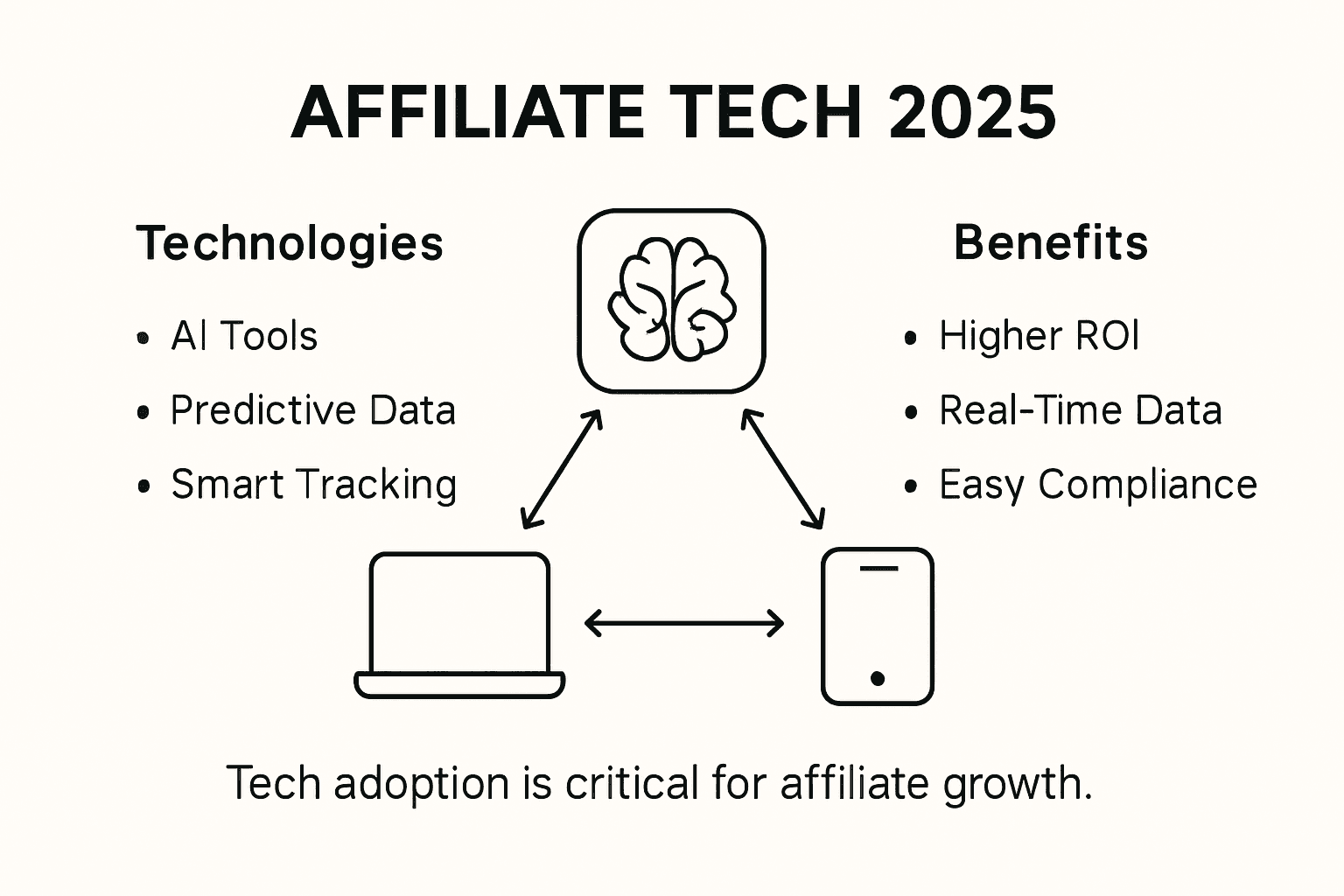
The following table highlights key technologies shaping affiliate marketing success:
| Technology | Function | Benefit to Marketers |
|---|---|---|
| Machine Learning | Real-time campaign optimisation | Improved targeting efficiency |
| Predictive Analytics | Partnership and trend prediction | Smarter commission strategies |
| Natural Language Processing | Contextual content generation | More engaging promotions |
| Automated Compliance Tools | Regulatory monitoring | Reduced compliance risk |
Pro Tip: Strategic Integration: Continuously invest time in understanding and experimenting with emerging AI technologies to stay ahead of competitive affiliate marketing landscapes.
Pro Tip: Tool Exploration: Investigate AI-powered marketing tools that can enhance your affiliate marketing capabilities and streamline complex analytical processes.
Compliance, Transparency, and Legal Shifts
Global data privacy regulations are fundamentally reshaping the affiliate marketing landscape, compelling marketers to adopt more sophisticated, transparent approaches to digital advertising. The implementation of stringent frameworks like GDPR, CCPA, and emerging international privacy laws demands a comprehensive transformation in how affiliate partnerships collect, manage, and utilise consumer data.
The privacy-first tracking methodologies represent a critical evolution in affiliate marketing compliance. Advanced technologies now enable consent-driven tracking mechanisms, server-side tagging, and granular data protection strategies that prioritise individual user privacy. Platform-level regulatory enforcement is becoming increasingly sophisticated, with automated compliance monitoring tools powered by artificial intelligence capable of detecting unauthorized content and ensuring rigorous adherence to complex regulatory requirements.
Transparency has emerged as a paramount consideration for affiliate marketers. Platforms and regulatory bodies now mandate explicit disclosure of affiliate relationships, requiring clear labelling of affiliate links and comprehensive documentation of marketing practices. This shift towards radical transparency not only ensures legal compliance but also builds crucial trust with consumers who demand greater insight into the commercial relationships underlying digital content and recommendations.
Pro Tip: Compliance Preparedness: Develop a comprehensive compliance documentation system that tracks all affiliate relationships, consent mechanisms, and data handling protocols.
Pro Tip: Legal Navigation: Explore AI-powered marketing tools that can help automate compliance tracking and reduce legal risks in your affiliate marketing strategies.
Avoiding Common Affiliate Mistakes in 2025
Comprehensive content monitoring strategies have become essential for affiliate marketers seeking to navigate the increasingly complex digital marketing landscape. The most significant pitfalls often emerge from inadequate compliance mechanisms, lack of transparency, and failure to adapt to rapidly evolving technological and regulatory environments. Successful affiliate marketers must develop robust systems that proactively identify and mitigate potential risks across multiple digital platforms.
The regulatory compliance landscape represents a critical area where many affiliate marketers stumble. Global regulations like GDPR, FTC guidelines, and ePrivacy requirements demand meticulous attention to detail. Precise disclosure practices are now non-negotiable, with affiliate marketers required to implement clear, transparent labelling of all commercial relationships and potential financial interactions. Failure to maintain comprehensive documentation and explicit consumer communications can result in significant legal and reputational risks.
Technological sophistication has become a fundamental requirement for modern affiliate marketers. Common mistakes include relying on outdated tracking mechanisms, neglecting data privacy protocols, and failing to leverage advanced analytics tools. Marketers must invest in continuous learning, embrace emerging technologies, and develop a proactive approach to understanding the intricate relationships between content creation, audience engagement, and regulatory compliance.
Pro Tip: Risk Management: Develop a quarterly compliance audit system that systematically reviews all affiliate content, tracking mechanisms, and disclosure practices.
Pro Tip: Technology Integration: Explore AI-powered marketing tools that can automate compliance tracking and provide real-time insights into potential regulatory risks.
Boost Your Affiliate Marketing Success with Practical Tools
Affiliate Marketing in 2025 demands a strategic approach that blends precision with powerful technology. The article highlights challenges such as navigating evolving compensation models like cost per sale, cost per lead, and cost per click, as well as integrating AI-driven content and compliance tools to enhance your campaigns. If you find yourself overwhelmed by compliance demands or uncertain about how to leverage emerging AI technologies for better targeting and personalisation, you are not alone. The key to excelling lies in embracing these changes with accessible resources tailored for all experience levels.

Discover how Marketing – Steve Pritchard Online can empower you with AI-powered content tools, easy-to-use lead-generation assets, and proven affiliate marketing resources designed to help you start or grow your online income stream faster with fewer headaches. No technical jargon and no hype just practical solutions for real people aiming for real results. Visit Steve Pritchard Online now and make 2025 the year you turn affiliate marketing trends into your own success story.
Frequently Asked Questions
What are the key trends in affiliate marketing for 2025?
The key trends include the rise of niche-specific affiliate programmes, enhanced personalisation through machine learning algorithms, and greater transparency in affiliate partnerships.
How do different affiliate compensation models work?
The primary models include Cost Per Sale (CPS), which rewards affiliates for direct sales, Cost Per Lead (CPL), which compensates for generating potential customer contacts, and Cost Per Click (CPC), which rewards traffic generation. Each model serves different strategic needs for businesses.
How is technology impacting affiliate marketing effectiveness?
Emerging technologies like machine learning and predictive analytics are enhancing precision, enabling real-time campaign optimisation and personalised recommendations. This allows marketers to better target their audience and improve conversion rates.
What compliance measures should affiliate marketers implement in 2025?
Affiliate marketers should establish comprehensive compliance documentation systems, ensure clear labelling of affiliate relationships, and adopt privacy-first tracking methodologies to align with global data privacy regulations.