More than 60 percent of affiliate marketers struggle to keep audiences engaged with plain product links. Whether you are a British newcomer or just starting out elsewhere, understanding how graphics can transform your campaigns is vital. Integrating professional, eye-catching visuals into your affiliate strategy helps simplify messages, grab attention, and inspire customer action. This guide reveals proven graphic design techniques that make affiliate offers stand out and drive real results.
Table of Contents
- Graphics Defined In Affiliate Campaigns
- Types Of Graphics Used By Affiliates
- How Graphics Increase Engagement And Conversions
- Best Practices For Graphics In Campaigns
- Common Graphic Mistakes To Avoid
- Real Examples Of Graphics Driving Results
Key Takeaways
| Point | Details |
|---|---|
| Importance of Graphics | Graphics are essential for conveying marketing messages effectively and enhancing consumer engagement in affiliate campaigns. |
| Types of Graphics | Various graphic formats, such as infographics and banners, serve distinct purposes in capturing attention and simplifying information. |
| Best Practices | Consistent branding, high-quality visuals, and responsive design are critical for successful affiliate marketing graphics. |
| Mistakes to Avoid | Common design pitfalls include inconsistent branding, cluttered visuals, and poor technical optimisation, which can diminish campaign effectiveness. |
Graphics Defined in Affiliate Campaigns
In the dynamic world of digital marketing, graphics represent strategic visual assets designed to communicate marketing messages efficiently and attract consumer attention. Affiliate marketing leverages these visual communication tools to simplify complex product information and enhance brand messaging. Research indicates that graphics serve multiple critical functions beyond mere aesthetic appeal, functioning as powerful communication channels that improve consumer understanding and engagement.
Within affiliate campaigns, graphics encompass diverse visual formats including infographics, banners, social media images, product illustrations, and comparative visualisations. These graphics are meticulously crafted to perform specific marketing objectives: capturing audience interest, explaining product features, highlighting value propositions, and creating emotional connections with potential customers. Digital marketing studies demonstrate that infographics, in particular, can dramatically improve information retention and consumer influence by presenting complex data in visually digestible formats.
Effective affiliate marketing graphics share fundamental characteristics that distinguish them from generic visual content. They must be strategically designed to align with brand identity, target audience preferences, and specific campaign goals. Key design elements include clean visual hierarchy, compelling colour schemes, readable typography, and clear call-to-action messaging. Professional graphics transform abstract product benefits into tangible, relatable visual narratives that resonate with potential buyers and drive engagement.
Pro tip: When creating affiliate marketing graphics, always prioritise clarity and simplicity over complex design, ensuring your visual message can be understood within three seconds of viewing.
Types of Graphics Used by Affiliates
Affiliate marketers utilise a diverse range of graphic formats to communicate product value and engage potential customers. These visual assets are strategically designed to capture attention, simplify complex information, and drive conversions. By unleashing affiliate superpowers with AI, marketers can enhance the effectiveness of their graphic design strategies across multiple platforms.
The primary graphic types employed in affiliate marketing include infographics, product banners, social media graphics, comparison charts, and landing page visuals. Infographics excel at presenting statistical data and product comparisons in a visually digestible format, while product banners provide quick, eye-catching representations of offers. Social media graphics are tailored for specific platforms, using platform-specific dimensions and design principles to maximise engagement. Comparison charts help potential customers understand product benefits by presenting information in a clear, structured manner.
Each graphic type serves a unique purpose in the affiliate marketing ecosystem. Product illustrations demonstrate features and benefits, creating visual narratives that resonate with target audiences. Animated graphics and GIFs can add dynamic elements to marketing materials, increasing viewer retention and interest. Video thumbnails and preview graphics are particularly effective in attracting clicks and generating initial interest in affiliate offers. Marketers must carefully select and design graphics that align with brand identity, target audience preferences, and specific campaign objectives.
Here’s a concise overview highlighting the main graphic types used by affiliates and their marketing advantages:
| Graphic Type | Typical Use Case | Marketing Benefit |
|---|---|---|
| Infographic | Statistical data, product comparisons | Enhances retention, influences |
| Product Banner | Offers, promotions | Attracts quick attention |
| Social Media Graphic | Platform-specific posts | Boosts social engagement |
| Comparison Chart | Feature/value comparisons | Clarifies competitive advantage |
| Animated Graphic/GIF | Dynamic product showcase | Increases viewer retention |
Pro tip: Create a consistent visual style across all graphic types to build brand recognition and trust among your audience, using similar colour schemes, typography, and design elements.
How Graphics Increase Engagement and Conversions
Graphics play a transformative role in affiliate marketing by bridging the communication gap between products and potential customers. Digital marketing research demonstrates that visual content significantly enhances user engagement by providing easily digestible information that captures attention instantaneously. By converting complex product details into visually appealing representations, graphics reduce cognitive load and enable faster comprehension of marketing messages.

The psychological impact of graphics extends beyond mere information presentation. Visual elements trigger emotional responses that text alone cannot achieve, creating instant connections with target audiences. On social media platforms, strategically designed graphics can increase click-through rates by making affiliate offers more attractive and accessible. Compelling visuals help potential customers visualise product benefits, transforming abstract concepts into tangible, desirable outcomes. Social media marketing tactics reveal that authentic, integrated graphics prompt followers to take immediate actions, such as clicking affiliate links and exploring product offerings.
Successful graphics in affiliate marketing leverage several key psychological principles to drive conversions. Colour psychology, strategic image placement, and visual hierarchy guide viewers’ attention towards critical information and desired call-to-action points. Infographics, comparison charts, and product illustrations serve as powerful conversion tools by simplifying complex information and highlighting unique selling propositions. By creating a visual narrative that resonates with target audience needs and preferences, affiliate marketers can significantly enhance the persuasive power of their marketing materials.
Pro tip: Test multiple graphic variations using A/B testing to identify which visual designs generate the highest engagement and conversion rates for your specific audience.
Best Practices for Graphics in Campaigns
Developing effective graphics for affiliate marketing campaigns requires a strategic approach that balances visual appeal with clear communication objectives. Creating powerful affiliate content demands careful consideration of design elements that capture attention and drive user engagement. Successful graphics must align with brand identity, target audience preferences, and specific marketing goals, ensuring that every visual asset serves a precise purpose in the conversion funnel.
Design consistency emerges as a critical principle in graphic development. Marketers should establish a cohesive visual language that includes uniform colour palettes, typography, and graphic styles across all marketing materials. This approach helps build brand recognition and trust, allowing potential customers to quickly identify and connect with affiliate offers. Key design considerations include maintaining appropriate resolution, using high-quality images, and ensuring graphics are optimised for different platforms and devices. Responsive design becomes crucial, with graphics that adapt seamlessly to various screen sizes and viewing contexts.
Technical considerations play an equally important role in graphic effectiveness. Compression techniques should balance image quality with file size, ensuring rapid loading times without sacrificing visual clarity. Alt text and metadata become critical for accessibility and search engine optimisation, enabling graphics to contribute to broader marketing performance. Marketers must also consider cultural nuances and audience demographics when selecting imagery, avoiding generic stock photos in favour of authentic, relatable visuals that genuinely connect with target audiences. Understanding colour psychology, visual hierarchy, and emotional triggers can transform graphics from mere decorative elements into powerful conversion tools.
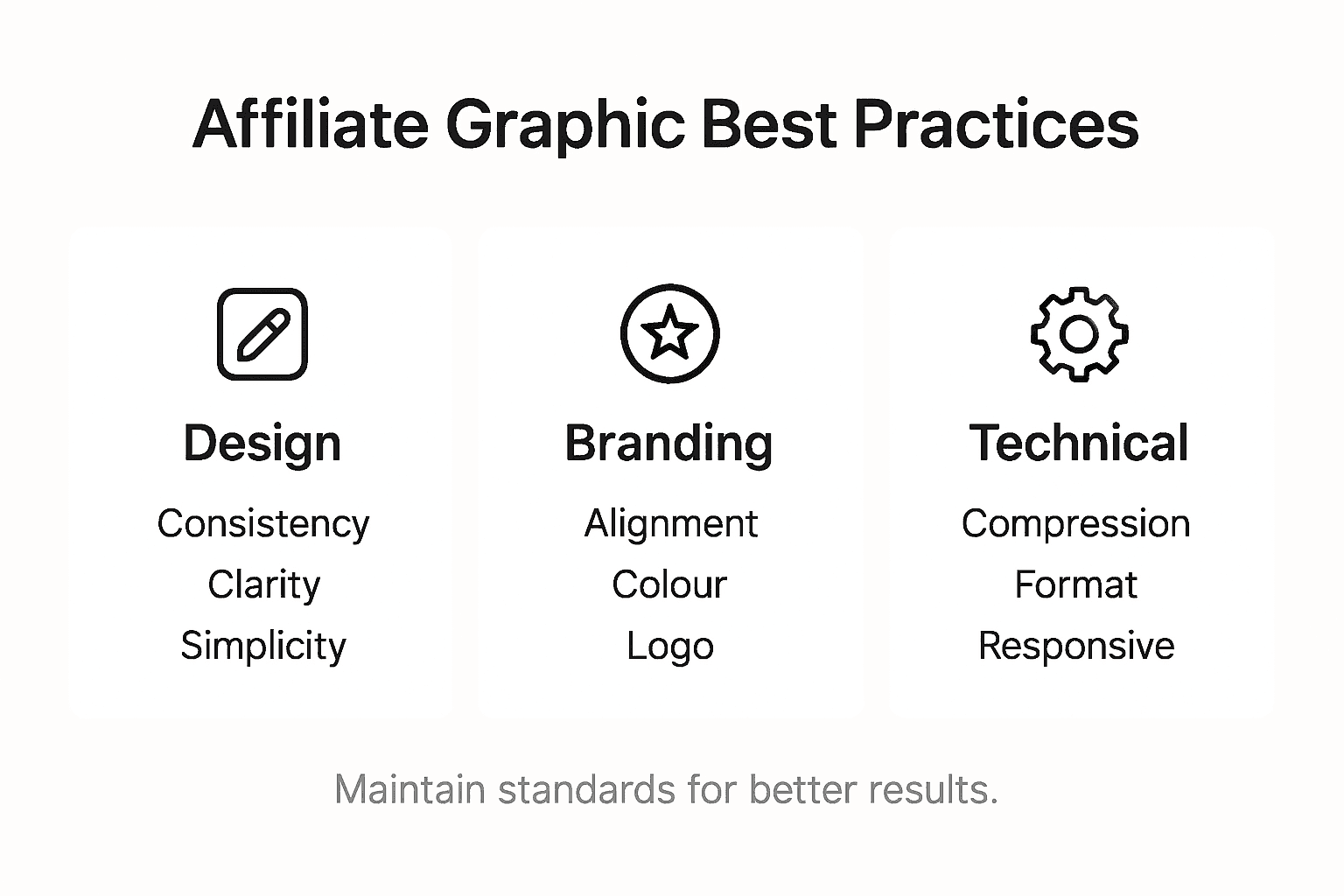
To further clarify best practices, here’s a table summarising the most impactful design principles for affiliate campaign graphics:
| Design Principle | Importance | Consequence of Neglect |
|---|---|---|
| Consistent Branding | Builds brand trust | Audience confusion, weak identity |
| High Resolution | Professional appearance | Unclear visuals, poor impression |
| Strategic Colour | Enhances mood and action | Reduces readability, wrong impact |
| Responsive Design | Optimises all platforms | Alienates mobile users |
Pro tip: Create a comprehensive design style guide that outlines your brand’s visual standards, ensuring consistency and professionalism across all graphic assets.
Common Graphic Mistakes to Avoid
Affiliate marketers frequently encounter graphic design pitfalls that can significantly undermine campaign effectiveness. Using AI-powered content generation tools can help mitigate some of these common design errors, but understanding fundamental mistakes remains crucial. Inconsistent branding represents one of the most prevalent graphic design mistakes, where marketers create visuals that lack cohesive visual identity, confusing potential customers and diluting brand recognition.
Overloading graphics with excessive information emerges as another critical error that diminishes visual communication impact. Successful graphics should communicate core messages quickly and clearly, avoiding cluttered designs that overwhelm viewers. Common mistakes include using multiple competing fonts, incorporating too many colours, cramming excessive text into limited visual space, and selecting low-resolution or generic stock imagery that fails to engage target audiences. Complex graphics that require significant cognitive effort to interpret will typically result in reduced user engagement and lower conversion rates.
Technical design errors can also substantially compromise graphic effectiveness in affiliate marketing campaigns. Poorly optimised images that load slowly, graphics incompatible with different device screen sizes, and visuals lacking appropriate alt text for accessibility represent significant technical mistakes. Marketers must also avoid culturally inappropriate or stereotypical imagery that might alienate potential customers. Colour choices require careful consideration, as inappropriate colour combinations can create visual discord, reduce readability, and potentially trigger negative psychological responses that undermine marketing objectives.
Pro tip: Regularly conduct user testing and gather feedback on your graphics to identify and eliminate design elements that might be hindering audience engagement and conversion potential.
Real Examples of Graphics Driving Results
Digital marketing research highlights compelling case studies demonstrating how strategic graphics can dramatically transform affiliate marketing performance. Comparative infographics have proven particularly powerful, enabling marketers to showcase product advantages through visually engaging narratives that simplify complex information and guide consumer decision-making processes. Successful campaigns leverage graphics that tell a story, moving beyond mere product presentation to create emotional connections with potential customers.
One notable example involves health and wellness affiliate programmes that utilised before-and-after transformation infographics. These graphics strategically combined statistical data, personal testimonials, and visual representations of results, leading to significant increases in click-through and conversion rates. Another impactful approach emerged in technology product marketing, where interactive graphics allowing users to compare technical specifications became instrumental in driving consumer engagement. By transforming dry technical details into dynamic, easily digestible visual representations, these graphics bridged the understanding gap between complex product features and consumer benefits.
Social media platforms have become particularly fertile ground for graphics-driven affiliate marketing success. Short-form video graphics, animated product demonstrations, and visually striking carousel posts have demonstrated remarkable engagement potential. Marketers who craft graphics that provide genuine value—whether through entertainment, education, or practical insight—consistently outperform those relying on traditional static advertising methods. The key lies in creating graphics that don’t just showcase products but genuinely solve problems or answer audience questions, positioning the affiliate as a trusted resource rather than a mere sales channel.
Pro tip: Create a graphic content library that tracks performance metrics, allowing you to systematically refine and optimise your visual marketing approach based on real audience response data.
Unlock the Power of Graphics in Your Affiliate Campaigns Today
Struggling to create clear, compelling affiliate marketing graphics that truly engage and convert your audience? This article highlights how well-designed visuals reduce complexity, build emotional connections, and boost user engagement. If you want to avoid common pitfalls like inconsistent branding or cluttered designs and instead craft graphics that showcase your product’s value clearly and instantly, you need the right tools and resources tailored to your goals.
Explore the Marketing – Steve Pritchard Online category to find practical, beginner-friendly digital products designed to simplify your graphic creation process. From AI-powered content tools that speed up design to lead-generation assets that amplify your message, everything here is built to help you start earning faster. There is no need to get lost in complicated workflows or technical headaches when you can access proven marketing templates and affiliate resources all in one place. Visit Steve Pritchard Online now to boost your affiliate campaigns with powerful graphics that convert and watch your results soar.
Frequently Asked Questions
How do graphics enhance affiliate marketing campaigns?
Graphics enhance affiliate marketing campaigns by simplifying complex information and improving user engagement. They provide visually appealing representations that can quickly communicate key product features and benefits, ultimately increasing click-through and conversion rates.
What types of graphics are most effective in affiliate marketing?
Effective graphic types in affiliate marketing include infographics, product banners, social media graphics, comparison charts, and animated visuals. Each type serves a specific purpose such as presenting data, attracting attention, and clarifying product benefits.
What are some common mistakes to avoid when using graphics in affiliate campaigns?
Common mistakes include inconsistent branding, cluttered designs with excessive information, and using low-resolution images. It’s crucial to maintain clarity and a cohesive visual identity to prevent confusing potential customers and weakening brand recognition.
How can I measure the effectiveness of graphics in my affiliate marketing efforts?
You can measure the effectiveness of graphics by tracking engagement metrics such as click-through rates and conversion rates. A/B testing different graphic variations can also help identify which designs resonate best with your target audience.
Recommended
- Unleash Your Affiliate Superpowers with AI
- PromoBlitz – AI-Powered Affiliate Content Generator | Steve Pritchard Online
- Products – AI-Powered Marketing Tools | Steve Pritchard Online
- Sales Page – Steve Pritchard Online
- Choosing the Right Online Advertising Strategy for Your Business: A Comprehensive Guide – Digital Marketing Agency – Market Link Solutions
- Role of Banners in Advertising Success for Business
- Infographic Videos: Making Your Data Come Alive – Kicker Video