More than 80 percent of British shoppers say that bonus offers influence their purchasing decisions, yet many still feel confused by complex promotions. In a crowded market, understanding what makes these incentives work is crucial for both consumers and businesses hoping to stand out. This guide clarifies the strategies behind bonus offers, showing how well-crafted promotions can drive sales, foster customer loyalty, and avoid common pitfalls that harm brand trust.
Table of Contents
- Defining Bonus Offers and Core Concepts
- Types of Bonus Offers in Digital Business
- How Bonus Offers Drive Conversions and Loyalty
- Legal and Ethical Considerations for Offers
- Common Pitfalls and Mistakes to Avoid
Key Takeaways
| Point | Details |
|---|---|
| Importance of Bonus Offers | Bonus offers serve as strategic tools to enhance consumer engagement and stimulate sales, acting on principles of reciprocity. |
| Types of Bonus Offers | Digital businesses utilise a range of bonus strategies such as discounts, cashback, and referral bonuses to create compelling value propositions. |
| Psychological Drivers | Effective bonus offers leverage psychological triggers, enhancing perceived value and simplifying decision-making for consumers. |
| Legal and Ethical Considerations | Businesses must ensure transparency and ethical design in bonus offers to maintain consumer trust and comply with legal standards. |
Defining Bonus Offers and Core Concepts
Bonus offers represent strategic marketing techniques designed to incentivise consumer engagement and purchasing behaviour. These promotional tactics are powerful tools that businesses use to attract attention, drive sales, and create immediate value for potential customers. At their core, bonus offers function as short-term sales promotions aimed at stimulating rapid consumer action and product interest.
The fundamental structure of bonus offers typically involves providing additional value beyond the standard product or service purchase. This might include complementary items, percentage discounts, cashback rewards, free trials, or bundled packages that enhance the perceived worth of the original transaction. Bonus offers operate on a psychological principle of reciprocity, where consumers feel they are receiving something extra, which can significantly influence their purchasing decisions.
Marketing research reveals that bonus offers are not merely promotional gimmicks but sophisticated strategies with measurable impacts. Comparative analytics demonstrate how these promotional techniques can substantially influence consumer behaviour and business performance. The effectiveness of bonus offers depends on several critical factors:
- Perceived value of the bonus
- Relevance to target audience
- Clarity of offer terms
- Timing and presentation of the promotion
- Alignment with broader marketing objectives
Successful bonus offers require a nuanced understanding of consumer psychology and strategic marketing principles. They must strike a delicate balance between providing genuine value and maintaining the profitability of the underlying business transaction. Marketers must craft these offers with precision, ensuring they are attractive enough to motivate action while remaining economically sustainable.
Types of Bonus Offers in Digital Business
Digital businesses leverage a diverse range of bonus offer strategies to attract and retain customers. These promotional techniques are carefully designed to create compelling value propositions that motivate immediate purchasing decisions. E-commerce promotions have evolved far beyond traditional marketing approaches, offering sophisticated methods to engage potential buyers and stimulate sales growth.

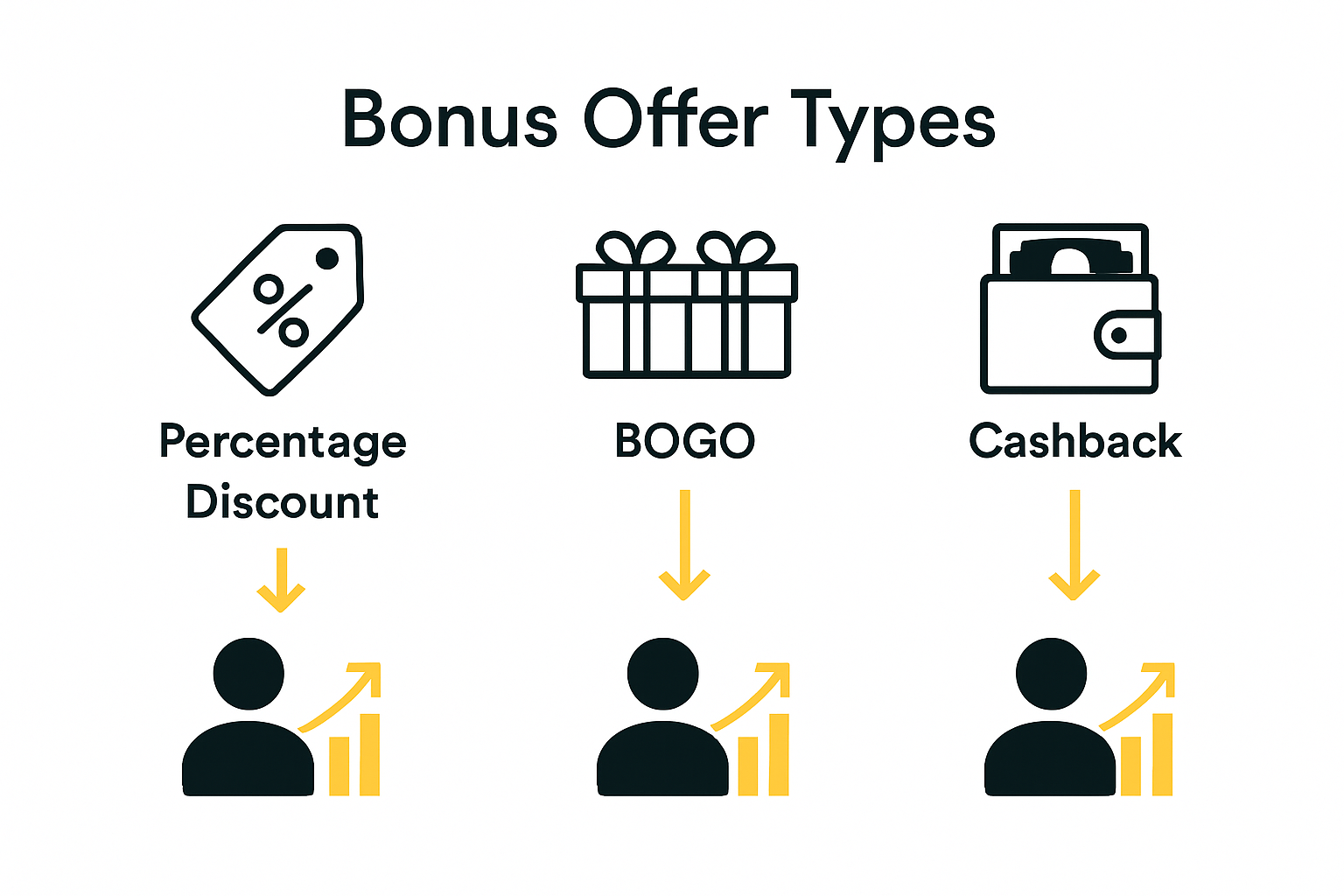
One prominent category of bonus offers includes transactional incentives such as Buy One Get One Free (BOGO) deals, multi-buy promotions, and complimentary product bundles. These strategies encourage customers to increase their purchase volume by providing tangible additional value. E-commerce promotional tactics often combine multiple approaches to maximise customer engagement and revenue generation.
The spectrum of bonus offers in digital business is remarkably diverse, encompassing various strategic approaches:
- Percentage Discounts: Immediate price reductions on products
- BOGO Offers: Free additional products with specific purchases
- Cashback Rewards: Monetary returns based on purchasing activity
- Bundle Packages: Grouped products at reduced combined pricing
- Free Shipping Thresholds: Complimentary delivery above certain spending levels
- Referral Bonuses: Incentives for introducing new customers
Successful digital businesses understand that bonus pay structures must be strategically crafted to align with specific marketing objectives. The most effective bonus offers balance immediate customer attraction with long-term relationship building, creating sustainable engagement that extends beyond a single transaction.
How Bonus Offers Drive Conversions and Loyalty
Conversion strategies in digital marketing rely heavily on sophisticated psychological triggers that motivate customer behaviour. Digital rewards play a critical role in transforming casual browsers into committed purchasers by creating tangible, immediate value propositions that resonate with consumer motivations. These strategic incentives tap into fundamental psychological principles of reciprocity and perceived benefit.
The mechanics of bonus offers extend far beyond simple price reductions. Bonus funnels are sophisticated marketing mechanisms designed to systematically guide potential customers through a carefully constructed journey of perceived value. By strategically positioning additional benefits at key decision-making points, businesses can dramatically increase the likelihood of purchase completion and subsequent customer loyalty.
Key psychological drivers that make bonus offers effective include:
- Perceived Value Enhancement: Customers feel they are receiving more than they are paying for
- Risk Reduction: Bonuses act as a form of purchase insurance
- Emotional Engagement: Creates a sense of excitement and exclusivity
- Reciprocity Trigger: Customers feel compelled to respond to generous offers
- Decision Simplification: Additional benefits help overcome purchase hesitation
Successful bonus offer strategies require nuanced understanding of customer psychology. Businesses must design offers that feel genuinely valuable, align with customer expectations, and create a compelling narrative of mutual benefit. The most effective bonus offers transform transactional interactions into relationship-building opportunities, establishing trust and encouraging long-term customer loyalty.
Legal and Ethical Considerations for Offers
Navigating the complex landscape of bonus offers requires a sophisticated understanding of both legal frameworks and ethical implications. Marketing promotion strategies demand rigorous scrutiny to ensure they maintain transparency, fairness, and compliance with regulatory standards. Businesses must carefully design their promotional approaches to avoid potential legal pitfalls while maintaining consumer trust.
Compensation structures and bonus mechanisms represent more than simple marketing tactics; they are intricate legal instruments that require meticulous planning and ethical consideration. The critical challenge lies in balancing short-term incentive generation with long-term reputational integrity, ensuring that bonus offers do not inadvertently mislead or exploit consumer vulnerabilities.
Key legal and ethical considerations for designing bonus offers include:
- Transparency of Terms: Clear, unambiguous description of offer conditions
- Accurate Representation: Precise communication of actual value and limitations
- Non-Discriminatory Design: Ensuring equal accessibility across consumer segments
- Data Protection Compliance: Protecting consumer information during promotional activities
- Consent and Opt-out Mechanisms: Providing genuine choice for participants
- Truthful Marketing Claims: Avoiding exaggerated or false promotional statements
Successful bonus offer strategies require a proactive approach to legal and ethical governance. Businesses must continuously evolve their promotional frameworks, integrating robust compliance mechanisms that protect both organisational interests and consumer rights. The most effective bonus offers are those that create genuine value, build trust, and demonstrate a commitment to ethical marketing practices.
Common Pitfalls and Mistakes to Avoid
Bonus offer strategies can quickly become counterproductive when businesses fail to understand their nuanced implementation. Internet marketing promotions frequently encounter critical errors that can dramatically undermine their intended objectives, potentially causing long-term damage to brand perception and financial performance.
Marketing promotional analyses reveal that many organisations inadvertently create unsustainable expectations through poorly designed bonus structures. The most significant risks emerge when businesses prioritise short-term gains over strategic, sustainable customer relationship development.
Critical pitfalls in bonus offer design include:
- Margin Erosion: Offering discounts that compromise profitability
- Expectation Management: Creating unsustainable customer price expectations
- Perceived Value Dilution: Recurring discounts that reduce brand premium
- Complex Redemption Processes: Overly complicated bonus claim mechanisms
- Inconsistent Application: Unequal or arbitrary bonus distribution
- Insufficient Performance Tracking: Failing to measure promotional effectiveness
Successful bonus offer strategies demand meticulous planning, continuous performance evaluation, and a sophisticated understanding of consumer psychology. Businesses must design offers that provide genuine value, maintain brand integrity, and create meaningful engagement without compromising long-term financial sustainability.
Unlock the True Power of Bonus Offers for Your Online Business
The essential guide to bonus offers online reveals how crucial it is to design promotions that drive conversions while maintaining your brand’s value. If you have struggled with creating bonus offers that balance appeal and profitability without confusing your customers or eroding margins then you are not alone. Many face challenges like managing perceived value, simplifying redemption processes, and aligning marketing tactics with long-term growth goals.
Steve Pritchard Online provides beginner-friendly tools designed specifically to help you overcome these challenges effortlessly. From AI-powered content tools to quick-start digital side-hustle kits you will find everything needed to build sustainable bonus offer strategies that increase sales and customer loyalty. Start creating transparent and compelling bonus offers with practical marketing templates and lead-generation assets that make online business easier, clearer, and more rewarding.
Discover how to transform your promotional efforts into lasting online income by visiting Steve Pritchard Online. Empower your journey with Affiliate Marketing Resources and Marketing Templates that eliminate overwhelm and help you start earning quicker. Take the next step now and unlock bonus offer success with tools designed for normal people leading normal lives.
Frequently Asked Questions
What are bonus offers?
Bonus offers are marketing strategies that provide additional value to consumers to incentivise purchasing behaviour, often including discounts, free products, or cashback rewards.
How do bonus offers drive customer loyalty?
Bonus offers enhance perceived value, reduce purchasing risks, and engage customers emotionally, encouraging them to return for future purchases due to the positive experience created.
What types of bonus offers are commonly used in digital marketing?
Common types of bonus offers include percentage discounts, Buy One Get One Free (BOGO) deals, cashback rewards, bundle packages, free shipping thresholds, and referral bonuses.
What mistakes should businesses avoid when implementing bonus offers?
Businesses should avoid margin erosion from excessive discounts, creating unrealistic expectations, poor clarity in offer terms, and overly complex redemption processes to maintain brand integrity and profitability.