Nearly every aspiring affiliate marketer has felt the frustration of pouring effort into a campaign only to see conversions stall. Whether you are working with a British audience or targeting customers around the world, mastering landing pages is non-negotiable for driving results. A single well-designed landing page can out-convert a complicated website by over 300 percent. This guide breaks down the essentials so you can create focused, high-impact landing pages that guide visitors straight to action and grow your sales.
Table of Contents
- Landing Pages Defined For Digital Marketing
- Types Of Landing Pages And Their Uses
- Core Elements Of Effective Landing Pages
- How Landing Pages Drive Conversions
- Beginner Mistakes To Avoid With Landing Pages
Key Takeaways
| Point | Details |
|---|---|
| Purpose of Landing Pages | Landing pages are strategically designed to convert visitors into leads or customers by focusing on a single marketing objective. |
| Types of Landing Pages | Various types exist, such as Lead Capture Pages and Sales Pages, each tailored to specific marketing goals and audiences. |
| Core Elements | Effective landing pages incorporate concise headlines, strong CTAs, and minimal navigation to maximise conversion potential. |
| Common Mistakes | Avoid information overload, unclear value propositions, and technical performance issues to enhance landing page effectiveness. |
Landing Pages Defined for Digital Marketing
In the world of digital marketing, a landing page represents a focused, strategic webpage designed with one primary objective: converting visitors into leads or customers. Unlike traditional websites with multiple navigation options, landing pages are meticulously crafted standalone web destinations serving a singular marketing purpose.
A landing page functions as a precision-targeted digital tool that bridges the gap between a marketing campaign’s initial promise and the desired user action. When potential customers click through from an email, social media advertisement, or search engine result, they arrive at a page engineered specifically to guide them towards making a specific decision – whether that involves purchasing a product, signing up for a newsletter, or requesting more information. The hallmark of an effective landing page is its ruthless elimination of distractions, concentrating all visual and textual elements on encouraging visitor conversion.
Typically, landing pages incorporate several strategic design elements to maximise conversion potential:
- A clear, compelling headline that immediately communicates value
- Concise, persuasive copywriting that addresses visitor needs
- A prominent, visually striking call-to-action (CTA) button
- Minimal navigation options to prevent user distraction
- Social proof elements like testimonials or trust badges
- Mobile-responsive design for seamless viewing across devices
Pro-tip: Always conduct A/B testing on your landing page elements to incrementally improve conversion rates and understand precisely what resonates with your target audience.
Types of Landing Pages and Their Uses
Digital marketers have developed a diverse arsenal of landing page types, each strategically designed to target specific audience segments and achieve unique conversion objectives. Multiple landing page variations exist, enabling businesses to craft precise communication strategies that align with distinct marketing goals.
The primary landing page categories include:
- Lead Capture Pages
- Purpose: Collect visitor contact information
- Typical elements: Email signup form, value proposition
- Goal: Build marketing database
- Click-Through Pages
- Purpose: Warm up potential customers before purchase
- Typical elements: Product benefits, persuasive description
- Goal: Prepare visitors for final conversion
- Microsites
- Purpose: Provide deeper exploration of specific campaigns
- Typical elements: Multiple interconnected pages
- Goal: Comprehensive brand storytelling
- Sales Pages
- Purpose: Direct product or service sales
- Typical elements: Detailed product information, testimonials
- Goal: Immediate transaction completion
- Splash Pages
- Purpose: Create initial brand impression
- Typical elements: Bold imagery, concise messaging
- Goal: Capture immediate visitor attention
Landing page classification depends critically on understanding audience intent and precise campaign objectives. Successful digital marketers recognise that no single landing page template suits every scenario, necessitating strategic customisation for maximum effectiveness.
Here is a comparison of common landing page types and their best-fit marketing scenarios:
| Landing Page Type | Ideal Use Case | Target Audience |
|---|---|---|
| Lead Capture | Early-stage interest capture | New prospects |
| Click-Through | Pre-purchase warm-up | Hesitant buyers |
| Microsite | Brand storytelling campaigns | Niche or segmented users |
| Sales Page | Urgent direct selling | Ready-to-buy visitors |
| Splash Page | Brand awareness or promotion | All incoming visitors |
Pro-tip: Map your landing page type directly to your specific marketing funnel stage to ensure maximum relevance and conversion potential.
Core Elements of Effective Landing Pages
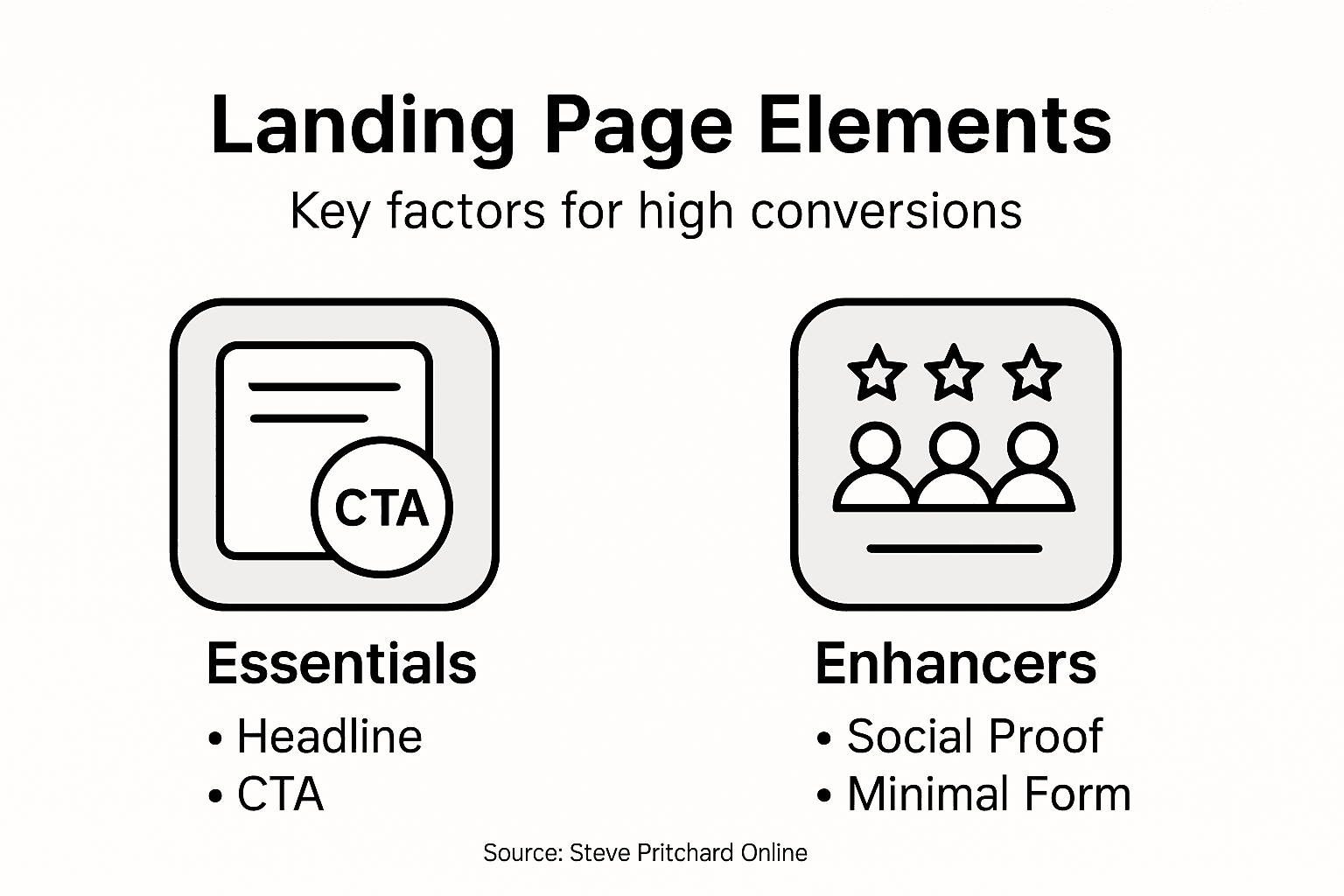
Crafting a high-performing landing page requires careful integration of strategic design elements that work harmoniously to drive conversions. Compelling landing page components transform a simple webpage into a powerful marketing tool capable of capturing visitor attention and motivating desired actions.
The foundational elements of an effective landing page include:
- Headline: A sharp, attention-grabbing statement that immediately communicates unique value proposition
- Subheadline: Provides additional context and reinforces the primary message
- Visuals: High-quality images or videos that illustrate product benefits
- Social Proof: Testimonials, client logos, or trust badges that establish credibility
- Call-to-Action (CTA): A prominent, action-oriented button with clear, motivating text
- Form: Streamlined data collection mechanism with minimal required fields
Successful landing pages strategically optimise user experience by eliminating unnecessary navigation elements and focusing entirely on guiding visitors towards a single, specific conversion goal. This laser-focused approach minimises distractions and increases the likelihood of transforming website visitors into qualified leads or customers.

The table below summarises best practices for optimising landing page conversion:
| Practice | Benefit | Implementation Tip |
|---|---|---|
| Single clear CTA | Improves visitor focus | Use prominent contrasting button colour |
| Minimal navigation | Reduces exit rates | Remove top and side menus |
| Strategic use of trust signals | Builds credibility and confidence | Display client logos and testimonials |
| Mobile responsiveness | Expands audience reach | Test on multiple devices and browsers |
Pro-tip: Conduct regular A/B testing on individual landing page elements to incrementally improve conversion rates and understand precisely what resonates with your target audience.
How Landing Pages Drive Conversions
The fundamental mechanism of landing pages revolves around creating a hyper-focused environment designed to transform casual website visitors into committed customers. Conversion-driven design strategies leverage psychological triggers and strategic communication to guide potential clients through a deliberate decision-making pathway.
Key psychological conversion drivers include:
- Clarity of Purpose: Immediate communication of exact value proposition
- Emotional Resonance: Connecting with visitor’s specific desires or pain points
- Reduced Cognitive Load: Minimising decision-making complexity
- Trust Signals: Incorporating credibility indicators like testimonials
- Urgency Creation: Suggesting time-sensitive opportunities
- Risk Reduction: Offering guarantees or low-commitment entry points
The conversion process operates through a carefully engineered sequence where every element works synergistically. Visual design, compelling copywriting, strategic placement of trust indicators, and a crystal-clear call-to-action collaborate to nudge visitors from initial interest towards definitive action. By eliminating distractions and presenting a singular, compelling pathway, landing pages dramatically increase the probability of transforming casual browsers into engaged customers.
Pro-tip: Implement heat mapping and user behaviour tracking tools to understand precisely how visitors interact with your landing page elements and identify potential friction points.
Beginner Mistakes to Avoid With Landing Pages
Navigating the intricate landscape of landing page design requires awareness of common pitfalls that can undermine conversion potential. Critical landing page errors often stem from well-intentioned but misguided design choices that inadvertently repel potential customers.
The most prevalent beginner mistakes include:
- Information Overload
- Cramming too many details onto a single page
- Overwhelming visitors with excessive text
- Diluting the primary message and call-to-action
- Unclear Value Proposition
- Failing to communicate immediate benefits
- Using vague or generic marketing language
- Not addressing specific visitor pain points
- Technical Performance Issues
- Slow page loading times
- Poor mobile responsiveness
- Complex, multi-step forms
- Design Distractions
- Cluttered visual layouts
- Inconsistent colour schemes
- Multiple competing calls-to-action
Conversion-killing landing page mistakes often result from a lack of strategic focus and user-centric design. Successful landing pages strip away unnecessary complexity, presenting a laser-focused pathway that guides visitors seamlessly towards a singular, compelling action. By understanding and avoiding these common errors, digital marketers can dramatically improve their conversion rates and campaign effectiveness.
Pro-tip: Conduct regular user testing and implement heatmap tracking to identify and eliminate potential friction points in your landing page design.
Transform Your Landing Pages into Conversion Machines Today
Understanding what makes a landing page truly effective is only part of the journey. Many beginners struggle with common pitfalls like unclear value propositions and overwhelming information, as covered in the article. If you want to cut through the noise and create laser-focused landing pages that convert visitors into leads, you need practical, beginner-friendly tools designed for real-world success.
At Steve Pritchard Online we provide expertly crafted digital products to help you build and automate your online income stream without the usual tech headaches. Our selection includes lead-generation assets, marketing templates, and AI-powered content tools — all tailored to save you time and reduce overwhelm while making landing page creation straightforward and effective.
Ready to build landing pages that really work? Visit Steve Pritchard Online now and explore our step-by-step kits and resources designed to help you start turning visitors into customers faster. No hype, no fuss, just practical solutions that get results.
Frequently Asked Questions
What is a landing page in digital marketing?
A landing page is a standalone web page designed with a specific purpose, typically to convert visitors into leads or customers by focusing on a single marketing objective.
What are the key elements of an effective landing page?
Effective landing pages include a compelling headline, persuasive copy, a clear call-to-action (CTA), social proof, minimal navigation, and a mobile-responsive design to enhance user experience.
How do landing pages drive conversions?
Landing pages drive conversions by creating a focused environment that guides visitors through a decision-making process, utilising psychological triggers such as clarity, emotional resonance, trust signals, and urgency.
What common mistakes should I avoid when creating landing pages?
Common mistakes to avoid include information overload, unclear value propositions, technical performance issues, and distracting designs that dilute the primary call-to-action.
Recommended
- Sales Page – Steve Pritchard Online
- Sales Page – Steve Pritchard Online
- Products – AI-Powered Marketing Tools | Steve Pritchard Online
- PromoBlitz – AI-Powered Affiliate Content Generator | Steve Pritchard Online
- Creating Effective Landing Pages to Boost Conversions – seo analytic
- The #1 AI Landing Page Generator – Build Stunning Pages Fast
- Why You Need Landing Pages for Google Ads